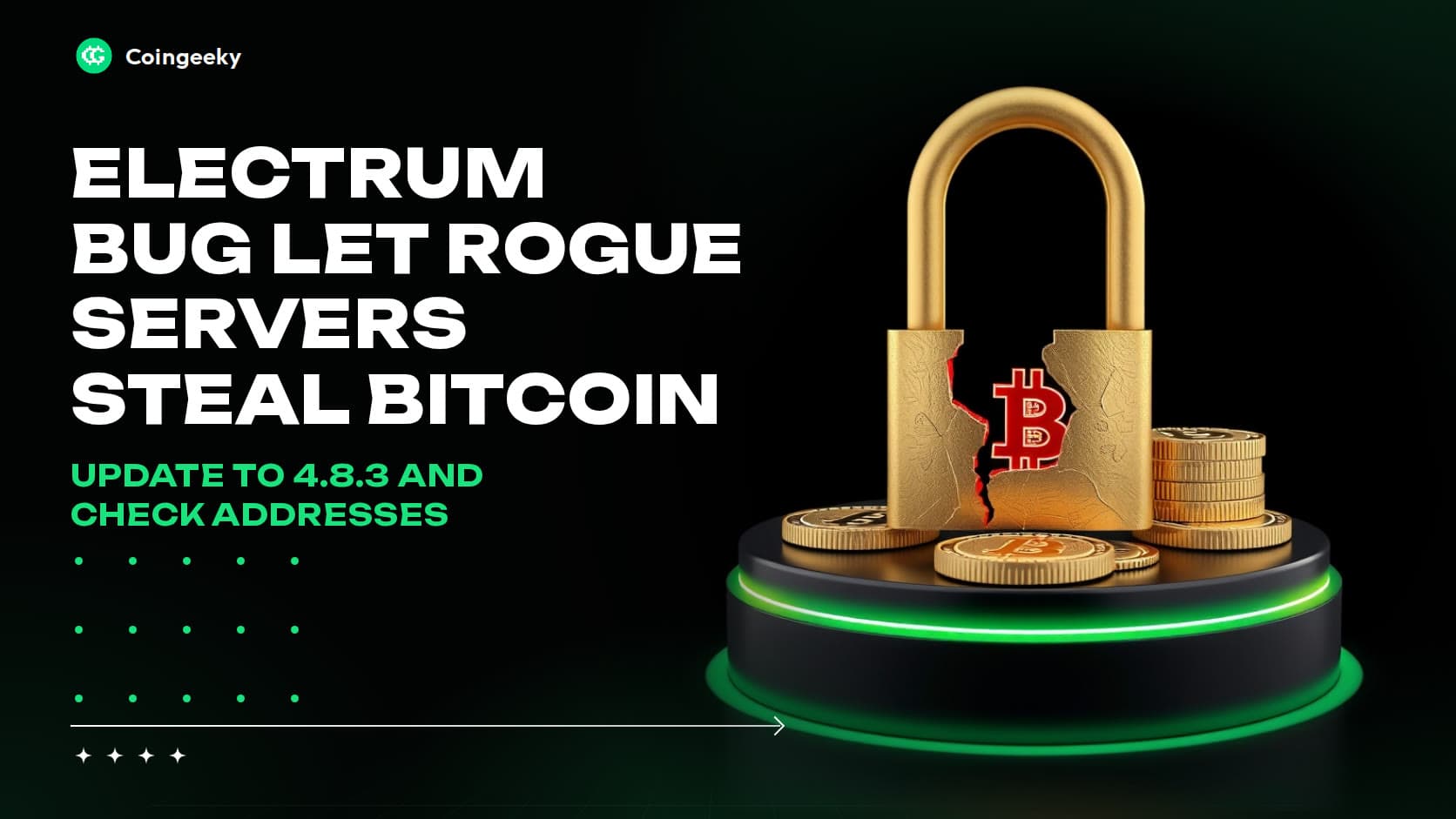

Thirteen days passed between the first user report of a suspicious Electrum transaction and the release of a patch. In the gap, at least one person watched bitcoin leave after clicking what looked like a routine button to speed up a payment.
The Electrum wallet bug is a nasty one because the victim did almost everything right. They sent a payment, saw it sit unconfirmed, and tried to bump the fee. That is the standard move.
The Wallet Took Rogue Servers at Their Word
Electrum is among the oldest software wallets in Bitcoin. Its developers disclosed the flaw on Saturday and warned that some servers were already exploiting it, according to CoinDesk's coverage. Unlike a full node, Electrum doesn't hold the chain itself. It asks outside servers for transaction history and uses them to broadcast payments.
Until the fix, the wallet trusted whatever those servers claimed about pending transactions, and it never checked the signatures. That opened a door. A malicious server could intercept a payment before the Bitcoin network ever saw it, then hand the user a forgery instead. The forgery sent the user's coins to an attacker's address. Its signatures were invalid, and Electrum didn't notice.
The wallet listed that forgery as a pending payment. Nothing moved on‑chain, so the user simply saw a transaction that looked stuck. In one reported case it carried no fee at all, which made the stall seem natural.
The trap closed when the user chose Replace‑by‑Fee, the Bitcoin feature that lets you swap an unconfirmed transaction for a higher‑fee version. Electrum took the fraudulent transaction and signed a valid replacement. Real signature, real coins, attacker's address.
There is a further touch of malice. The attackers built destination addresses that ended in the same four characters as the genuine one, so anyone who only glances at the tail of an address would be fooled. Plenty of us do exactly that, and I include myself.
Two Reports, One Confirmed Loss
The first report arrived on Oct. 11 from a user with a two‑of‑three multisignature setup using two Trezor devices. That person had verified the genuine payment on both hardware wallets, then later spotted a different outgoing transaction in the history. No loss of funds was reported in that case.
A second user wrote in on Oct. 18. This person had bumped the fee on a swapped‑in transaction and lost money. Developers haven't said how much, and they haven't named the malicious servers. Who runs them, and how many there are, remains unexplained.
Electrum shipped version 4.8.3 on Oct. 24. It now verifies signatures on unconfirmed transactions that spend coins from the user's own wallet. There is a catch: older versions stay exposed if they connect to a bad server. The developers' advice is to upgrade, and to read receiving addresses and amounts carefully before signing anything. People who connect only to servers they trust, their own included, were not exposed.
A Hardware Screen Only Answers What You Ask It
I keep coming back to the multisig user. Two hardware devices, both checked, and the attack still got far enough to plant a fake in the history. One reading is that the hardware did its job, since the user never signed the bad transaction and reported no loss. The other is that the protection was narrower than it looked. Hardware signing covers what the device shows you, and here the poisoned step sat in the software wallet's own record of what was pending. On the available facts I lean toward the second reading, though the first is fair.
The practical takeaways are dull but real. Update to 4.8.3. Read the full address, not the last few characters. If you have a spare machine and some patience, run your own server and this whole class of attack goes away for you.
Watch for two things: whether the developers publish the stolen amount and the server details, and whether other light wallets that trust remote servers get a hard look for the same assumption. If one wallet skipped signature checks on pending transactions, it is fair to ask who else did.