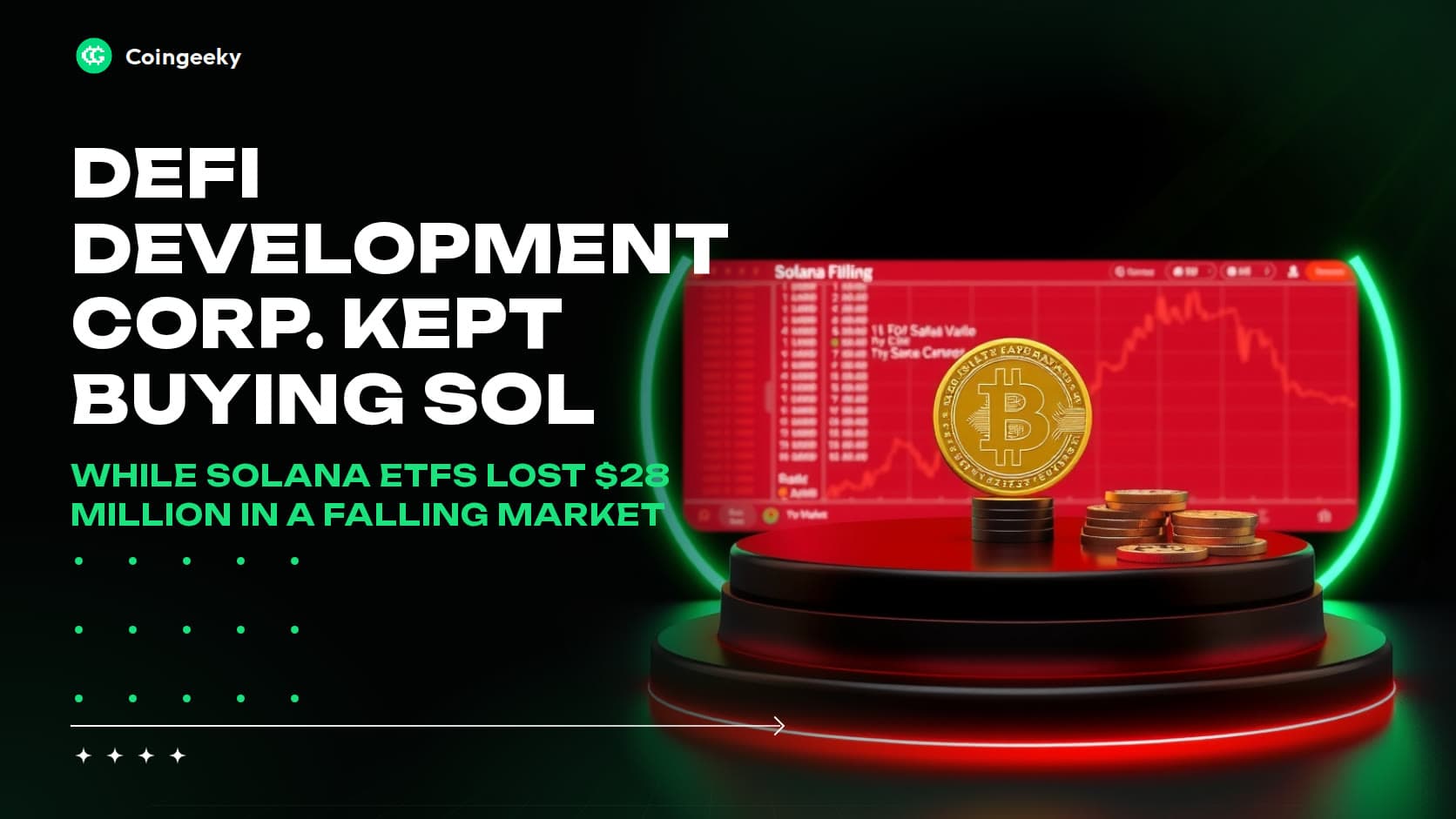

I want to talk about a purchase most people will scroll past. At Monday's price of $70.99, 9,482 SOL is worth about $673,000. That's the latest Solana buy from DeFi Development Corp., which also marked a 31st straight day of its CHAD dividend. By the standards of this market it's a small cheque. The setting is what makes it worth a look.
Bitcoin sits at $64,609 as I write, Ether at $1,823, Solana at $70.99. Everything is red, and the people who buy through regulated funds are leaving. A public company adding SOL anyway, and keeping a dividend running while it does, is behaving differently from the fund flows. I want to lay out both sides.
What DeFi Development Corp. Actually Did
The facts are short. The company added 9,482 SOL to its holdings, and its CHAD dividend streak reached 31 consecutive days. Do the arithmetic and you get roughly $673,000 at the current quote.
I can't tell you how the purchase was funded, or what the total SOL position looks like now. Neither detail has appeared in anything I've seen, and I'd rather leave the gap visible than fill it with a guess. Paying with operating cash and selling shares into weakness are very different ways to buy the same tokens.
The streak is the more interesting number. Thirty‑one days is a month of showing up, and nobody sets a daily rhythm like that by accident. The company wants its buyers, and its shareholders, to see steadiness as the brand.
The Fund Market Is Heading for the Exits
Now set that against the money moving through ETFs. U.S. spot bitcoin funds lost $185.4 million on Friday, according to Decrypt's ETF tracker. It was the seventh straight trading day of outflows. The week's damage came to about $829 million, after nearly $1.3 billion the week before.
Add it up and November has cost the funds roughly $2.1 billion. Cumulative net inflows since the January 2024 launch have slipped to $55.3 billion. Total net assets have fallen to $94.9 billion, under the $100 billion level they held for much of October.
Ether funds had a marginally better Friday, taking in $2.3 million and ending a six‑day losing run. That barely registers. Over the past five sessions those funds still saw roughly $336 million walk out, and the month's tally stands near $702 million.
Solana's funds are the ones that matter here. They lost about $28 million this week, though they still hold $1.6 billion in cumulative net inflows. Next to bitcoin's, that's a small leak, and I'd keep it in proportion. The direction is the same, though.
A Treasury Buyer Answers to Different People
I think the cleanest way to read this is by who answers to whom.
An ETF holder is a person with a brokerage screen and a nervous Friday afternoon. Many are advisers who have to explain a 15% weekly drop to clients. By Decrypt's count, bitcoin has fallen roughly that much in seven days and over 22% across a month, with worries about more Federal Reserve rate hikes wiping out the summer rally. When a client calls, the easiest answer is to cut the position.
A company running a Solana treasury has another audience. Its shareholders bought the strategy, not just the token, and the strategy is accumulation. Buying through a drawdown is, in theory, what they signed up for, and stopping would send its own signal.
That doesn't make the purchase wise. Consistent is the most I'd call it. A treasury company that goes quiet in the worst month in a long while invites questions about whether the model works when it's tested, so there's a pull toward buying visibly, even in modest amounts. That $673,000 is a statement of intent more than a balance‑sheet event.
I'd hold that view loosely. The company hasn't explained its reasoning for this buy, and I'm inferring from structure.
The Dividend Is the Part to Watch
A token purchase is cheap to announce and cheap to reverse. A dividend streak is a promise renewed every day, and each renewal costs something.
I don't have the mechanics of how CHAD pays out, and I won't pretend to. What I can say is that any recurring payout has to come from somewhere: cash on hand, yield from the assets, or new capital. In a calm market the third source is easy. When total crypto value has slid 4.5% in a day to about $2.3 trillion, it gets harder.
That's the stress test hiding inside a 31‑day counter. If the number keeps climbing through a stretch like this one, it says something real about how the company funds itself. If it stops, we'll learn the same thing faster.
There's also a plain optics problem for every company in this niche. When SOL fell about 12% to roughly $70 over the weekend, any treasury bought at higher prices went underwater on paper. Adding more at $70.99 lowers the average cost, which is the bullish framing. It also raises the exposure, which is the other one.
Not Everyone Is Selling
The fund outflows don't mean the institutions have left. According to its latest SEC filing, JPMorgan now holds close to $1 billion across bitcoin and crypto‑related securities. Those purchases predate the latest downturn, so they tell us what the bank thought before the slide, not how it feels now.
This week bitcoin touched its lowest level in about twelve weeks, and a wave of concentrated liquidations had already driven it below $69,000 earlier in the period. Ether fell 8.4% to about $1,790 over the weekend. The question for anyone holding Solana is whether the buyers who remain are enough to matter.
Here's my read. The fund side is the loud signal right now, and it points down. Treasury companies are a smaller, quieter group, and their purchases are easy to wave off. But they're the ones with a stated reason to keep buying, which makes them the steadiest bid left in a market short of bids.
They're also the most exposed to a long slide. Prediction markets on Myriad were putting a 99% chance on bitcoin trading below $66,000 on Monday, and the November low contracts are still open. If prices fall further and these companies' share prices sag with them, raising money to buy more gets more expensive.
Three Things Will Tell Us More Than This Purchase
First, whether the CHAD streak reaches day 32 and beyond while SOL trades near $70. Second, whether DeFi Development Corp. discloses how it paid for the 9,482 tokens and what its total holdings now are. Third, whether the Solana ETF outflows, so far a modest $28 million, widen or reverse once the Federal Reserve picture gets clearer.
My guess is the funds keep bleeding for a while and the treasury buyers keep buying, which will give us a clean test of which group read the market correctly. I wouldn't bet on the answer by Friday.