
I'll be straight about what just happened today, because it's the first genuinely positive macro catalyst Bitcoin has received in weeks, and the source of it is the last place I would have expected to find relief after a month of hawkish Fed messaging.
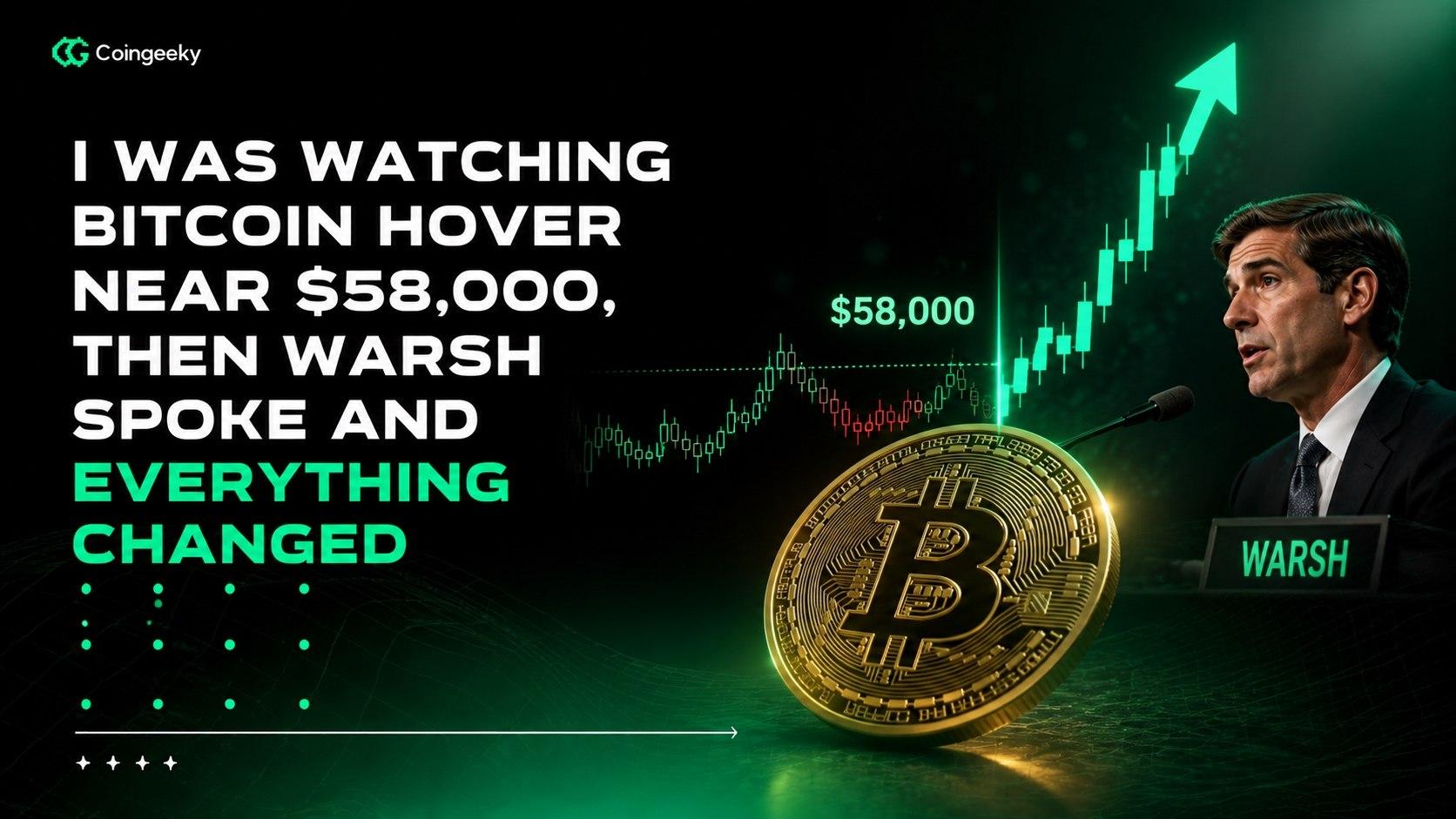
Federal Reserve Chair Kevin Warsh spoke at the European Central Bank's annual forum in Sintra, Portugal on Tuesday. His words were measured, deliberately non‑committal on rate timing, and yet they contained exactly the signal Bitcoin needed to climb back above $60,000.
Bitcoin gained more than 2% in 24 hours following his remarks, trading around $60,076. After touching 21‑month lows near $58,000 earlier this week, I'll take it.
What Warsh Actually Said
The key line was direct and unambiguous: "Inflation risks have come down." That's the most dovish public signal from Warsh since he took the Fed Chair role, and the market interpreted it immediately as a shift in tone from the hawkish posture that has been crushing risk assets all month.
He also reaffirmed the Fed's commitment to returning inflation to its 2% target, so this isn't a pivot away from price stability. But framing it as risks having come down, rather than remaining elevated, is a meaningfully different message from what the dot plot implied just two weeks ago when rate hike projections moved higher across every year through 2028.
Warsh declined to offer forward guidance on the next rate decision, saying policymakers would evaluate incoming data at their meeting in four weeks. That deliberate vagueness on timing was itself part of a coordinated shift I noticed across the panel.
Central Banks Are Moving Away From Forward Guidance
The Sintra forum brought Warsh alongside European Central Bank President Christine Lagarde, Bank of England Governor Andrew Bailey, and Bank of Canada Governor Tiff Macklem. All four of them broadly agreed on a shared directional change: central banks should step back from explicit forward guidance on interest rates.
Lagarde said she regretted feeling bound by forward guidance and prefers what she called framework guidance, explaining how the ECB reaches decisions without locking in a predetermined path. Warsh expressed the same view. His framing was that the Fed's job is to get policy right, and if communication tools make that harder, they should be discarded.
For crypto markets, this matters. The hawkish rate path projected in the latest dot plot had been one of the most persistent headwinds for Bitcoin all month. If the Fed is stepping back from explicit signaling and instead staying data‑dependent, it reintroduces the possibility of cuts that the market had largely stopped pricing in.
The AI Comment That Could Mean a Lot
There was a second part of Warsh's remarks that I think deserves more attention than it's getting. He flagged AI as a potential structural force that could reshape the U.S. economy and with it, monetary policy itself.
His argument was that unlike previous periods of financial engineering, businesses are now investing heavily in AI because they genuinely expect it to expand productive capacity. If AI delivers on that promise, expanding supply rather than just demand, it would be inherently disinflationary. More output from the same or fewer inputs means less price pressure, which means the Fed has more room to ease.
Warsh was careful to say it's too early to make that judgment definitively. But the fact that he named AI as a potential game‑changer for monetary policy, in his first major international appearance as Fed Chair, is not a throwaway line.
What This Means for Bitcoin Going Into Q3
I'm not declaring the bear market over based on one speech. The structural headwinds, record ETF outflows, the dollar near 13‑month highs, Bitcoin below every major moving average, don't vanish because Warsh sounded slightly less hawkish for one afternoon in Portugal.
But the tone shift matters. Bitcoin has been hammered for weeks by the narrative that the Fed is aggressively hawkish and rates are going higher for longer. Today's remarks introduced at least the possibility that narrative is peaking. And in markets, narrative shifts often precede price shifts by just enough time to catch people off guard.
$60,000 is back. Holding it is the next test.