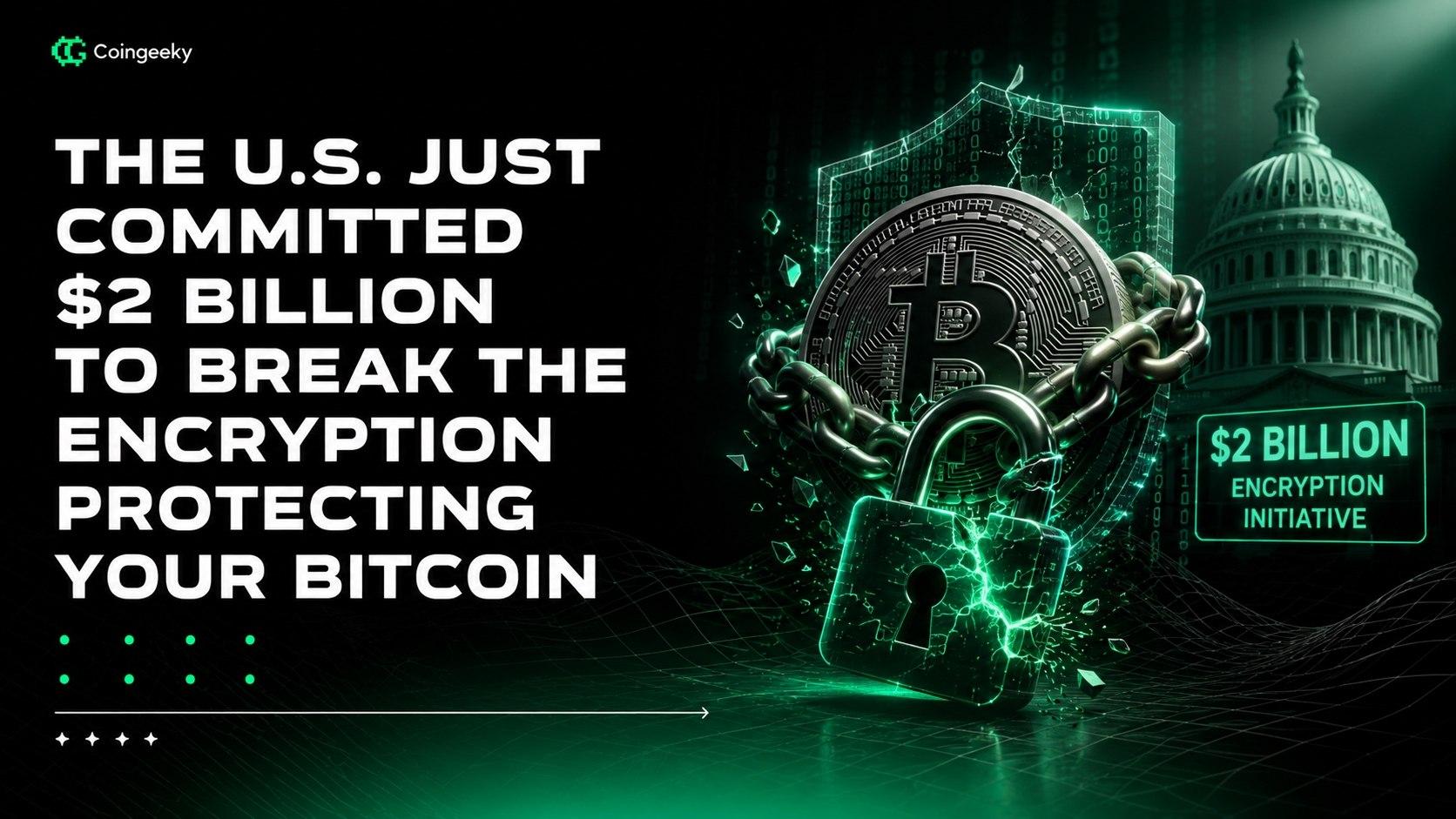

I cover crypto for a living, and I want to be direct about something most people in this space aren't talking about with enough seriousness. The U.S. Commerce Department just signed letters of intent to award over $2 billion to nine quantum computing companies. These are machines being built, at industrial scale, that could eventually break the cryptography protecting Bitcoin, Ethereum, and frankly the entire internet.
This is not a research grant. This is industrial policy with profit expectations attached.
What the $2 Billion Actually Buys
IBM is receiving $1 billion to establish a quantum‑grade superconducting wafer foundry. GlobalFoundries is getting $375 million for a multi‑architecture fabrication facility. The remaining $636 million is distributed across seven companies building quantum computers using different technical approaches, superconducting, trapped ion, photonic, and neutral‑atom systems.
When a government builds dedicated manufacturing infrastructure for a technology, it has stopped asking whether it works. It's asking how fast it can scale. Washington believes a cryptographically relevant quantum computer is no longer theoretical. It wants to get there first.
France moved the day after the U.S. announcement, with President Macron committing €1 billion to its quantum strategy. China had already funneled roughly $17.5 billion through regional venture funds before this U.S. move even landed. This is now a three‑way industrial race and it just compressed everyone's timeline.
Why Crypto Has a Unique Problem
The standard response to this kind of news is: match the funding, invest in post‑quantum cryptography research, and close the gap. That logic is wrong, or at least dangerously incomplete.
The problem with defending against a quantum computer isn't money, it's coordination. You can fund offense to converge on a single capability. You cannot fund defense to converge on adoption across millions of independent, uncontrolled endpoints.
Bitcoin is uniquely exposed to this. Every address that has ever sent funds has its public key sitting openly on‑chain. The moment elliptic curve cryptography breaks, those addresses become forgeable, and there is no way to recall or patch that exposure retroactively.
SSL deprecation worked because browser vendors could draw a line and force compliance. Bitcoin has no vendor, no central authority, no entity capable of setting a hard deadline and forcing the network to move. The defense has to be negotiated among stakeholders who must all agree voluntarily. That's the actual crisis.
The Deadlines Already Exist
What makes this particularly urgent is that the regulatory timeline is already written. NIST standards will deprecate RSA‑2048 and elliptic curve algorithms at 112‑bit security by 2030, and prohibit all quantum‑vulnerable public‑key algorithms entirely by 2035. National Security Memorandum 10 directs federal systems to migrate on the same horizon.
The Clarity Act, currently moving through Congress, gives regulators their first real framework over digital assets. That framework should require custodians, exchanges, and stablecoin issuers to publish post‑quantum migration plans with milestones tied to NIST's deadlines. The Treasury and the SEC have the standing to enforce it.
The Window Is Narrowing Fast
The institutions holding Bitcoin on behalf of ETF issuers, corporations, and sovereign funds have been waiting for someone else to move first. That strategy no longer makes sense.
The offense just got a $2 billion head start. The defense needs to stop waiting for urgency to arrive and start treating 2030 like the hard deadline it already is.