
What if the study of finance didn't just look at the past but also tried to guess what would happen in the future?
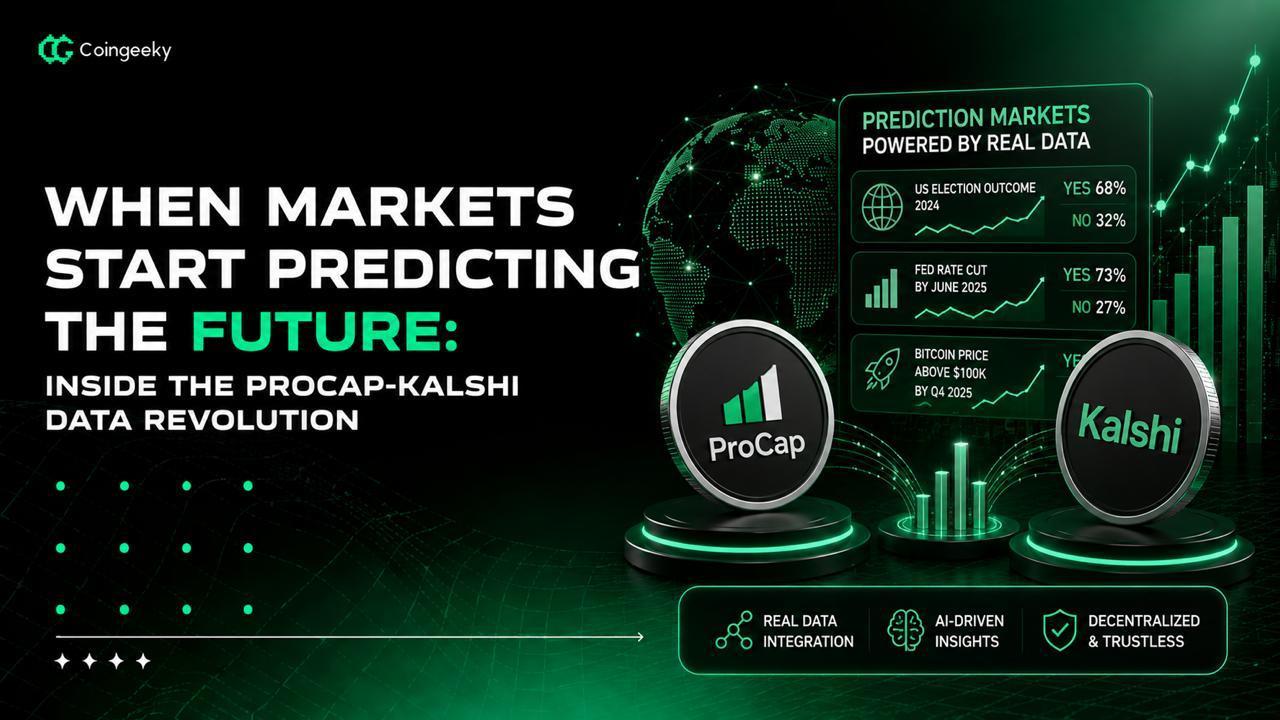
That’s the bold premise behind the recent partnership between ProCap Financial and Kalshi, a move that signals a major shift in how investors might consume data, interpret trends, and ultimately make decisions.
A New Kind of Signal: “Wisdom of the Crowds”
Kalshi is basically a regulated market for predictions. Users buy and sell contracts based on what will happen in the real world, such as changes in inflation rates or political events. These trades reflect collective expectations, essentially turning crowd sentiment into quantifiable probabilities.
ProCap’s idea is simple but powerful: take this raw prediction data and refine it into actionable investment intelligence. ProCap wants to create a new type of financial insight by combining Kalshi's real‑time data pipeline with its own AI‑driven research platform. This new type of insight will combine large‑scale human intuition with machine analysis.
From Data to Decisions
Traditional financial research relies heavily on historical data, analyst reports, and economic indicators. While useful, these sources often lag behind real‑time sentiment shifts. Prediction markets, on the other hand, continuously update as new information enters the system.
This partnership effectively transforms prediction markets into a live feed of “what people think will happen next.” And when processed through AI, that signal can evolve into:
Forward‑looking investment strategies
Early detection of macroeconomic shifts
Sentiment‑driven equity insights
That is, it's not just about data; it's also about when things happen.
Why This Matters Now
The financial world is undergoing a quiet transformation. Investors are no longer satisfied with static reports; they want dynamic, adaptive insights. This is reflected in ProCap's overall strategy, especially its growing focus on "agentic AI", self‑driving systems that look at huge amounts of data and come up with research in real time.
By adding prediction market data into this mix, ProCap is essentially upgrading its AI with a new input layer: collective human expectations.
This could be particularly valuable in volatile environments where traditional models struggle, think sudden policy changes, geopolitical tensions, or unexpected economic shocks.
A First‑of‑Its‑Kind Move
Notably, this marks the first time Kalshi has supplied its data directly to a financial research provider with paying subscribers. That alone makes this collaboration stand out.
It also reflects a broader trend: prediction markets are moving from niche curiosity to mainstream utility. From media partnerships to institutional adoption, their role in shaping narratives, and decisions, is expanding rapidly.
The Bigger Picture
This isn’t just a partnership; it’s a glimpse into the future of finance.
As AI systems become more sophisticated and data sources more diverse, the edge will belong to those who can interpret signals fastest and most accurately. Prediction markets are helpful in this case because they don't just report reality; they also predict it.
Of course, there are challenges. Prediction data isn’t perfect, and crowd sentiment can be wrong. But when combined with robust analytics, it becomes a powerful layer of insight rather than a standalone truth.
Final Thought
The ProCap–Kalshi collaboration hints at a world where investing is less about reacting and more about anticipating. It could change the way research is done by moving the focus from "What happened?" to "How did it happen?" to a far more valuable question: “What’s likely to happen next?”