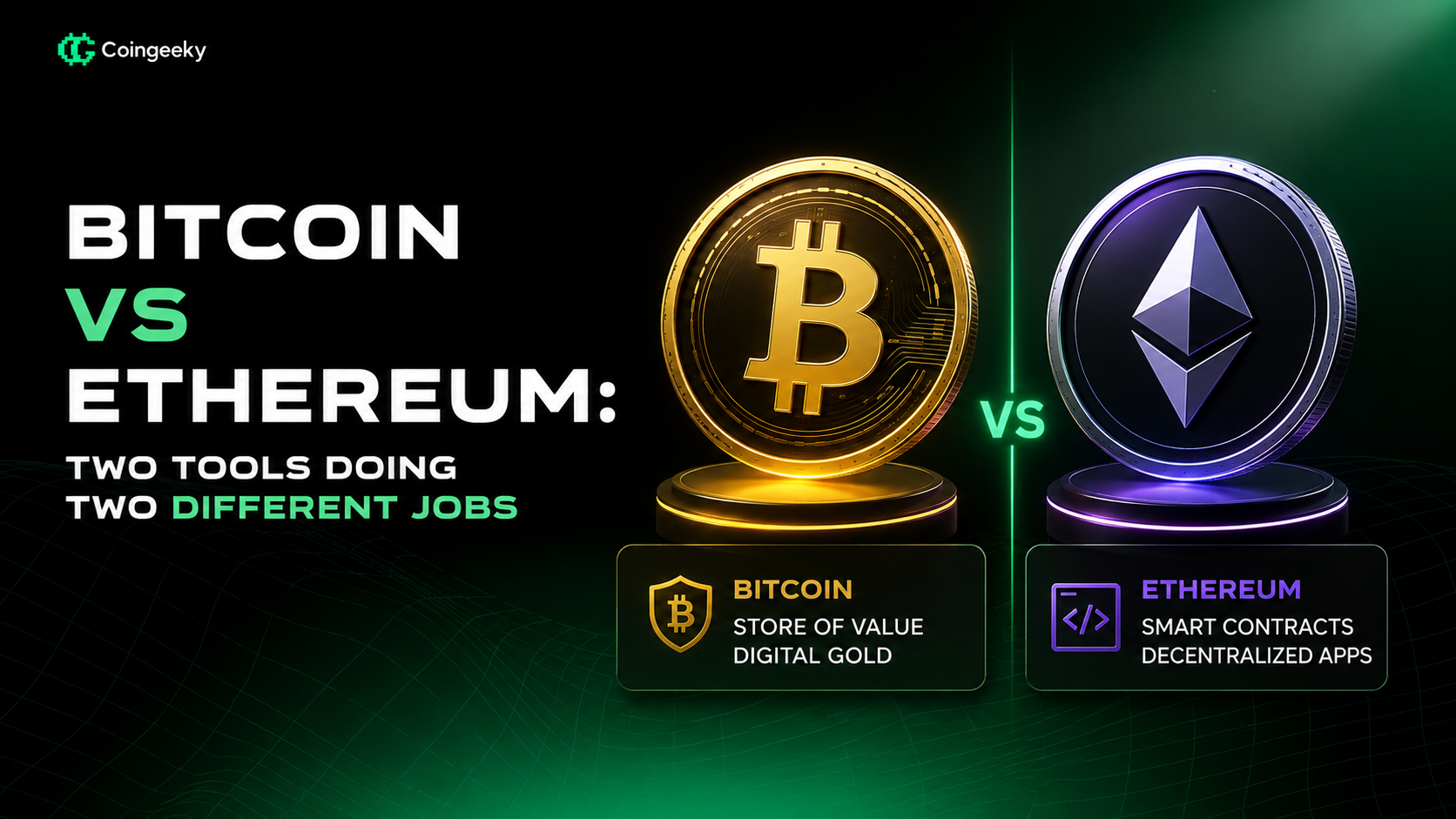

Somebody asked me last week which one they should buy, Bitcoin or Ethereum, like I was going to hand them a single answer with a bow on it. I didn't. I asked what they wanted the money to do. That question tripped them up, and honestly, it should trip most people up. The bitcoin vs ethereum debate gets framed as a fight, a boxing match with one winner and one loser, and I think that framing is the whole problem. It smuggles in an assumption that they're interchangeable, that you're picking between two versions of the same thing. You're not.
They aren't competing for the same job. That's the part nobody says out loud.
Bitcoin came first. It launched in 2009 from a whitepaper written by someone, or some group, calling themselves Satoshi Nakamoto, and nobody has ever proven who that actually was. The goal was narrow on purpose. Make digital money that no bank, government, or company controls. That's it. Bitcoin doesn't try to be clever. It tries to be money you can hold and move without asking permission, and it guards that job jealously.
Bitcoin vs Ethereum: what each was actually built for
Ethereum showed up in 2015, six years later, and it wanted something different. Vitalik Buterin and a group of co‑founders weren't trying to build better digital cash. They were building a platform. Think of Bitcoin as a calculator that does one thing extremely well, and Ethereum as a computer you can run programs on. Those programs are called smart contracts, and they're the reason DeFi, NFTs, and most of the stablecoins you've heard of live on Ethereum.
So one is money. The other is a place to build things, and money happens to be one of the things you can build there. That distinction matters more than any price chart.
Supply and monetary policy
Here's where the two really split. Bitcoin has a hard cap. There will only ever be 21 million coins, and that number is baked so deep into the protocol that changing it would break the entire social contract Bitcoin runs on. That scarcity is the pitch. It's why people call it digital gold. You know exactly how much exists and how much ever will.
Ethereum has no fixed cap. None. Its issuance adjusts based on how the network is running, and back in 2021 it added a mechanism that burns part of the fees users pay. During busy stretches, that burn can actually remove more coins than the network creates, so supply shrinks a little. It's a living policy, not a fixed one. Neither approach is wrong. They just answer different questions. Bitcoin answers "how do I know it's scarce?" Ethereum answers "how do I keep a working economy funded?"
I've watched people get genuinely upset that Ethereum won't commit to a hard number, as if that's a flaw someone forgot to fix. It isn't a bug. A platform that hosts a whole financial system needs some flexibility in how it pays for security, the same way a country doesn't lock its money supply in a vault and throw away the key. Bitcoin can afford rigidity because rigidity is the point. Ethereum can't, because it's trying to stay useful, not just stay scarce.
Consensus and energy use
Both networks need a way to agree on what's true without a central referee. This is where they used to look similar and now don't.
Bitcoin uses proof of work. Miners run machines that burn electricity to solve puzzles, and whoever solves one gets to add the next block. It's expensive by design. That cost is the security. Attacking the network would mean out‑spending everyone honest, which is wildly impractical. People criticize the energy use, and that criticism is fair to raise, but the energy is doing a job. It's not waste from Bitcoin's point of view. It's the wall around the vault.
Ethereum did it that way too, until 2022. Then came the Merge, a switch from proof of work to proof of stake. Instead of burning electricity, validators now lock up their own coins as collateral. Misbehave and you lose them. The result cut Ethereum's energy use by roughly 99.9%. That's not a rounding error, that's a near‑total drop. I remember how nervous people were before the Merge landed, like the whole thing might fall over. It didn't. It just worked, quietly, which is the best outcome any infrastructure upgrade can hope for.
So today, Bitcoin is deliberately energy‑heavy and Ethereum is deliberately not. Same starting philosophy, two very different endings.
Speed, fees, and how it feels to use
Using Bitcoin is simple. You send coins, the network confirms, done. There's a fee, and it can climb when the network is busy, but the transaction itself isn't doing anything fancy. Simplicity is the feature.
Ethereum charges what's called gas. Every action, sending funds, swapping tokens, minting an NFT, running a contract, costs gas because you're paying for computation, not just a transfer. When the network gets crowded, gas gets expensive, and that's a real pain point people complain about constantly. A lot of the recent work in the Ethereum world has been about pushing activity onto cheaper layers built on top of it, so the base chain handles settlement and the busy stuff happens elsewhere.
If you just want to hold and occasionally move value, Bitcoin feels cleaner. If you want to actually do things, lend, trade, mint, build, Ethereum is where that lives, gas and all.
Risk profiles are not the same
This is the part that gets glossed over. When you hold Bitcoin, your main risk is fairly contained. Will people keep treating scarce digital money as valuable? That's a big question, but it's one question.
Ethereum stacks more on top. You've got the value of ETH itself, plus the health of everything built on Ethereum, plus smart contract bugs, plus regulatory attention on DeFi and stablecoins, plus competition from other platforms trying to eat its lunch. More surface area, more ways to win, more ways to get hurt. That's not a knock. It's just a different shape of risk, and you should know which shape you're signing up for.
So which one, then?
I'll take a side, because dodging the question is annoying. It's not either/or. That's my actual stance.
If what you want is a store of value, something scarce you can hold for years and not think about, Bitcoin has the cleaner story. Fixed supply, simple design, hard to change, been around the longest. If what you want is exposure to where crypto actually gets used, the apps, the stablecoins, the financial plumbing, then Ethereum is the bet, because that activity mostly runs there.
Here's the thing most people miss: those goals aren't mutually exclusive. A ton of holders own both, and not because they can't make up their minds. They own Bitcoin for the store‑of‑value job and Ethereum for the ecosystem job, the same way you might own gold and also own shares in companies. Different tools, different reasons.
So stop asking which one wins. Ask what you need it to do. Once you answer that honestly, the choice tends to make itself, and sometimes the answer is both.