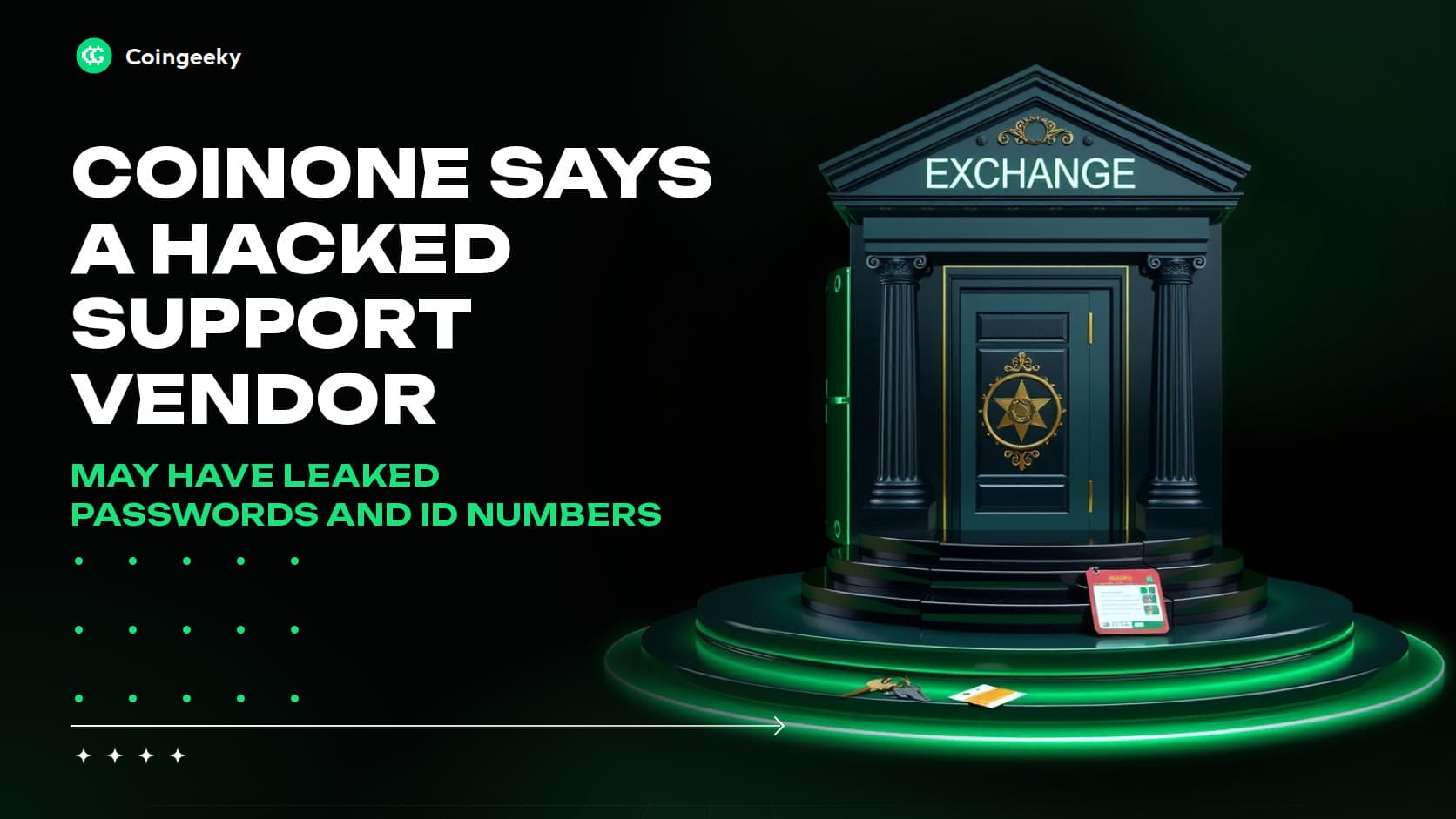

Passwords. National ID numbers. Bank account numbers. Wallet addresses. Coinone says all of it may have leaked after someone broke into the servers of a company it hired to run customer support. The Coinone data breach didn't touch the exchange's own systems, the company says. If your chat logs and tickets were sitting on a vendor's machines, that's thin comfort.
What Coinone Says Happened
According to Cointelegraph's report, an attacker got into servers run by MetaM, the outsourced support provider, on Thursday and viewed or pulled customer service records. Coinone says it found out the same day. It went public on Sunday.
What was exposed differs from one customer to the next, per Coinone. Think of it in layers. The first is identity: names, birth dates and national identification numbers. The second is contact and location: phone numbers, email addresses and home addresses. The third is money: bank account numbers, passwords, crypto wallet addresses and transaction IDs. Any single customer's file may hold some of these layers and not others.
Anyone who never contacted the support center wasn't affected, the exchange says. It hasn't said how many customers were. That's the number I most want to see, and it's missing.
Why a Support Desk Is Such a Juicy Target
Trading engines get the security budget. Help desks get a ticketing tool and a contractor. Yet that's where people paste screenshots of their ID, type out account details to prove who they are, and sometimes, remarkably, send a password to a stranger in a chat window.
The failure isn't only the vendor's. If an agent asks for a password, the process has already broken. A legitimate exchange shouldn't need one, and customers shouldn't hand it over. Coinone is now telling anyone who did share one to change it immediately.
Draining an account is the smaller worry. Coinone says its account, trading and wallet systems run separately from MetaM's servers, and it has seen no sign of a direct compromise. The larger worry is a convincing phone call. A scammer who knows your name, your birth date, the date you asked about a withdrawal and the transaction ID involved can sound exactly like Coinone. The company warned that fraudsters may impersonate it using details from past conversations. I'd assume they will.
There's a second‑order problem too. Wallet addresses sitting next to a real name and a home address tie an identity to an on‑chain balance that anyone can look up. A public address alone is harmless. Paired with a person's details, it tells a criminal who is worth targeting, and that's a different kind of risk from a stolen password. It's one more reason support tickets deserve the same care as the trading engine.
What Affected Users Should Do
I can't give financial advice, but the sensible hygiene is plain enough:
- Change any password you ever shared in a support chat, and anywhere else you reused it.
- Treat unsolicited calls, texts and emails that mention a past support case as suspect, even when the details are right. Those details are what leaked.
- Contact Coinone through the app or its official site, never through a link or number someone gave you.
- Watch for attempts to open accounts or loans in your name, since national ID numbers are in the mix.
Changing a password takes a minute. A leaked national ID number can't be rotated, which is why identity theft sits next to phishing in Coinone's warning.
Seoul Was Already Tightening the Screws
The news lands in the middle of a regulatory push. In October, South Korea's Financial Services Commission found security deficiencies at 130 of the 555 financial firms it reviewed, roughly one in four. Then on Thursday, the same day the attacker got into MetaM, the regulator said it would let crypto exchanges suspend withdrawals when a hack is suspected, and called for around‑the‑clock monitoring, as Cointelegraph noted.
Both measures target exchange infrastructure. This incident sits in the supply chain around it, and a withdrawal freeze does nothing for a customer whose ID number is in a contractor's database. If regulators want to close that gap, vendor oversight belongs in the rulebook. That could mean audit rights over outsourced providers, limits on what customer data a support contractor may store, and shorter retention for old tickets. None of that is exotic. Banks have lived with similar third‑party rules for years.
The exchange has also notified South Korean authorities about the incident. It follows a rough run of security headlines for the sector, including GOPAX halting trading and withdrawals to move all assets to cold storage, a story Cointelegraph linked alongside this one.
What to Watch
Three questions are still open. How many customers were hit? How long did the attacker have access before Coinone noticed? And will regulators count outsourced support providers as part of an exchange's security perimeter? Coinone's follow‑up statements and any action from the Financial Services Commission will show whether this stays a contained vendor problem or ends up changing the rules on who can hold exchange customers' data.
For anyone holding on Coinone, the practical read is simple. Your coins may be exactly where you left them, but your personal details may not be private anymore, and the next few weeks of suspicious calls are the real test.