
I've watched people treat dollar‑cost averaging like a cheat code. Buy a little every week, they say, and the market can't hurt you. That's not quite right. DCA is real, it's useful, and it's oversold. So let me walk through what it actually does to your money, where the math backs it up, and where it quietly costs you.
What DCA actually is
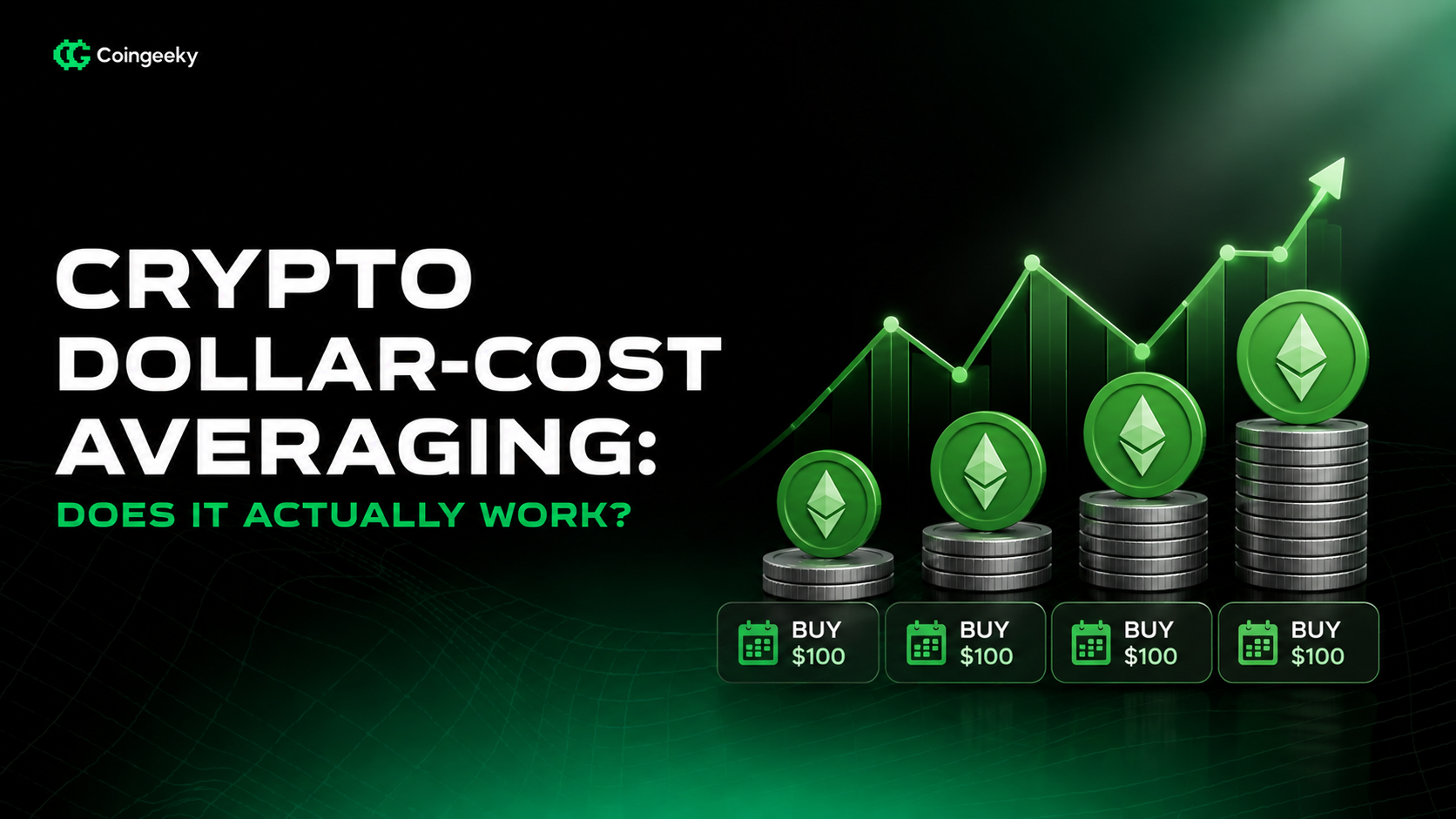
Dollar‑cost averaging means you invest the same dollar amount on a fixed schedule, no matter what the price is doing. A hundred bucks of Bitcoin every Monday. Two hundred of ETH on the first of the month. The amount stays flat. The number of coins you get flexes with the price.
That last part is the whole trick. When Bitcoin is cheap, your fixed hundred dollars buys more of it. When it's expensive, the same hundred buys less. You end up owning more coins at the low prices and fewer at the high ones, which is exactly the buying pattern you'd want but almost never pull off by hand.
The math, with actual numbers
Say you buy $100 of a coin four weeks running, and the price goes $10, then $5, then $8, then $12. Watch what happens.
- Week 1 at $10: you get 10 coins.
- Week 2 at $5: you get 20 coins.
- Week 3 at $8: you get 12.5 coins.
- Week 4 at $12: you get 8.33 coins.
You spent $400 and now hold 50.83 coins. Your average cost per coin is about $7.87. But the simple average of those four prices is $8.75. DCA got you a cheaper basis than the naive average because your money bought heaviest at the $5 dip. That gap is the mechanical benefit people are pointing at when they praise DCA.
Here's the catch that gets skipped. That benefit only shows up because the price bounced around. If the coin had just climbed steadily from $5 to $12, buying it all on day one at $5 would've crushed the DCA result. Which brings us to the fight everyone eventually has.
DCA versus lump sum, honestly
Vanguard ran the numbers on this years ago in traditional markets. Investing a lump sum immediately beat dollar‑cost averaging roughly 68 percent of the time across their historical windows. The reason is dull but decisive: markets go up more often than they go down, so cash you're holding back to spread out is cash that missed the average day's gain.
Crypto's long‑term chart drifts up even harder than stocks, spikes and all. So the same logic bites. If you have $12,000 today and you're confident in the asset over a five‑year horizon, the expected‑value move is usually to deploy it now, not trickle it in over a year while it drifts higher without you.
But expected value isn't the same as your value. Lump‑sum's edge is an average across thousands of scenarios. In the ugly ones, where you drop your whole stack in the week before a 50 percent crash, DCA is the clear winner and you sleep at night. Crypto produces those ugly weeks far more often than the S&P does.
When DCA underperforms
Three situations reliably make DCA the wrong call. First, a sustained bull run. Every week you wait to deploy the rest of your cash, the price is higher, so your later buys drag your average up instead of down. Second, when you already have a lump of cash sitting idle. That money isn't earning anything while it waits its turn, which is a real cost even if it's invisible. Third, on a coin that's actually dying. DCA into a token that keeps falling and never recovers just means you bought the whole way down. Averaging is not a substitute for conviction.
I want to be blunt about that last one. DCA does not reduce the risk of the asset itself. It reduces timing risk, the chance you picked a terrible single moment to buy. Those are different things. If you'd asked whether spreading entries protects you from a bad coin, the answer is no. For that you want real diversification, and it's worth reading how staking yields and other approaches fit into a wider plan.
The psychology angle, which is the real reason
Here's my actual take after years of watching this. The strongest argument for DCA has almost nothing to do with the math. It's behavioral.
Most people are terrible at buying dips. When Bitcoin is down 40 percent and the headlines are screaming, the exact moment the math says to buy, your gut says run. Lump‑sum investing assumes a version of you that stays calm and rational at the worst possible time. That version usually doesn't show up. DCA sidesteps the whole problem by removing the decision. You bought last Monday, you'll buy next Monday, and the crash just means this week's hundred dollars scoops up extra coins. No willpower required.
That's the trade you're really making. You give up some expected return in exchange for a system that keeps you invested when your emotions would otherwise wreck you. For a lot of investors, myself included on the days I'm honest, that's a fantastic deal.
Automation, because manual DCA breaks
The dirty secret of DCA is that people quit doing it right when it matters most. The market tanks, fear sets in, and they skip a week. Then another. The whole point was to buy through the fear, and manual discipline is exactly what fear destroys.
So automate it. Most major exchanges let you set recurring buys. If you're operating more on the DeFi side, Blazpay runs a DCA feature as part of its DeFi and AI aggregator, automating recurring buys and routing each one to the best available rate across sources rather than eating whatever a single venue quotes. The rate‑shopping matters more than it sounds over dozens of buys. Whatever tool you pick, the goal is the same: take your future scared self out of the loop entirely.
Automation also pairs well with the boring stuff that compounds. Once your buys run themselves, you can point attention at yield, and there are several passive income strategies that stack on top of a steady accumulation habit.
So does it actually work?
Yes, with an asterisk. DCA reliably does two things: it hands you a lower average cost than random manual buying during choppy markets, and it keeps you in the game through the crashes that shake everyone else out. What it doesn't do is beat lump‑sum investing on average, and it can't save you from a bad asset.
My honest read for July 2026: if you're getting paid every two weeks and you want to accumulate crypto without staring at charts, DCA is close to perfect. Automate it, pick assets you'd hold through a brutal winter, and let it run. If you've got a pile of cash and genuine conviction, the math leans toward deploying it now. Most people aren't in that second camp, and most people are better off with a schedule than with their own timing instincts.