
Trust is everything in DeFi, and one exploit just destroyed a significant amount of it. In the weeks since a $292 million hack drained assets from a LayerZero‑powered bridge, the industry has been voting with its feet. And Chainlink is winning by a wide margin.
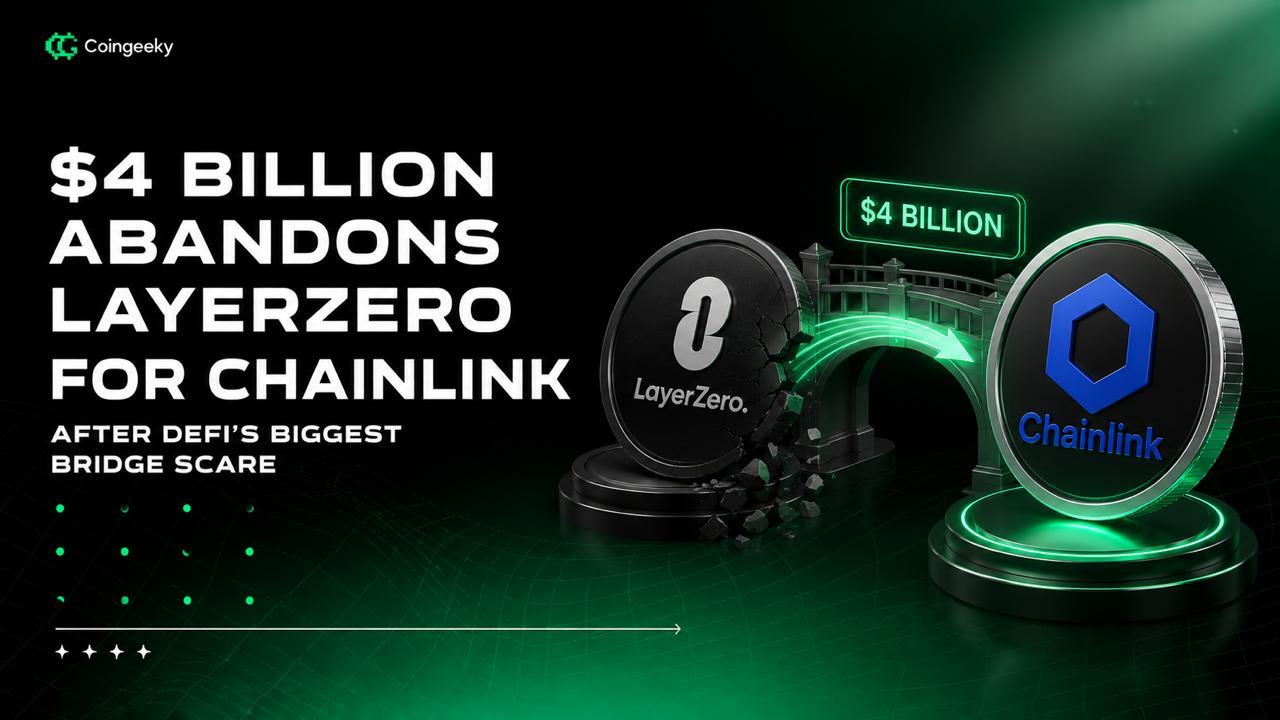
Crypto firms managing roughly $4 billion in assets are moving to Chainlink CCIP due to renewed scrutiny over bridge security following an exploit.
This is not a gradual drift. It is a coordinated industry‑wide flight to safety, and it is still accelerating.
The Exploit That Started the Exodus
The shift accelerated after a $292 million exploit drained 116,500 rsETH from Kelp DAO's LayerZero‑powered bridge in April 2026. LayerZero later said it made a mistake by allowing its own verifier network to secure high‑value assets in the configuration used.
The team behind the exploited bridge publicly acknowledged and apologised for what they described as lax security oversight. The admission has intensified scrutiny on LayerZero's operational practices, with industry participants now questioning whether the protocol can restore the trust lost in the aftermath of the incident.
For LayerZero, the damage went well beyond one bad day.
Who Has Already Moved
The migration is not theoretical. It has been happening in real time across some of DeFi's most significant protocols.
Total assets migrated to Chainlink CCIP now exceed $4 billion across Kelp DAO, Solv, Re.xyz, Kraken, and Lombard.
Solv Protocol shifted $700 million in tokenised Bitcoin, including SolvBTC and xSolvBTC, from LayerZero to CCIP on May 7.
Kraken announced it was replacing LayerZero with Chainlink CCIP as the exclusive cross‑chain infrastructure for kBTC and all future Kraken wrapped assets, citing enterprise‑grade security, ISO 27001 compliance, and SOC 2 Type 2 certification as the reasons for the switch.
Lombard Is the Latest and Largest to Join
DeFi protocol Lombard is the latest firm to join the shift, deprecating LayerZero and migrating more than $1 billion in Bitcoin‑backed assets to Chainlink's Cross‑Chain Interoperability Protocol after a security review following the Kelp DAO exploit.
Lombard said CCIP gives it independent node operators, built‑in rate limits, and audited infrastructure. The firm is also adopting Chainlink's Cross‑Chain Token standard, which lets tokens move across chains through a burn‑and‑mint model.
Jacob Phillips, co‑founder of Lombard, said internal reviews showed that Chainlink CCIP provides the highest level of cross‑chain security in the industry.
Why Chainlink Is the Clear Beneficiary
Chainlink is not just winning by default. Its infrastructure is genuinely better positioned for what institutions now demand.
Chainlink CCIP holds ISO 27001 and SOC 2 Type 2 certifications and routes transfers through 16 independent node operators. The protocol has supported over $28 trillion in cumulative on‑chain transaction value and averages approximately $90 million in weekly token transfers.
Johann Eid, Chief Business Officer at Chainlink Labs, said the industry is witnessing a continued flight to safety.
What This Means for LayerZero
LayerZero has since removed support for 1‑of‑1 DVN configurations and announced plans to move most routes toward stricter 5‑of‑5 verifier setups. Despite the migrations, the protocol said more than $9 billion in bridged assets moved through its infrastructure since April 19.
The broader message is now clear across the market: interoperability systems are increasingly judged according to institutional infrastructure standards rather than experimental crypto‑native expectations.
The bridge security debate is over, at least for now. Chainlink won it. And $4 billion in assets is the proof.