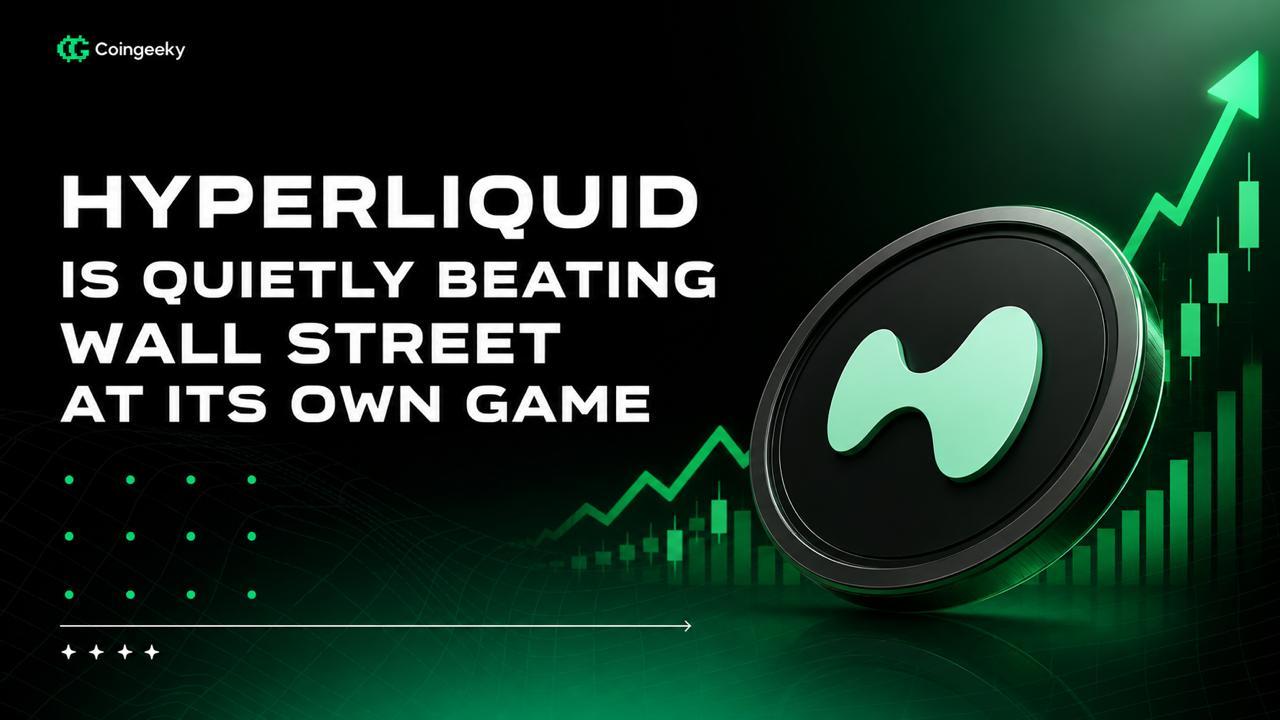

When one of the most respected names in digital asset management calls a three‑year‑old DeFi protocol a potential financial services juggernaut, people stop and listen. That is exactly what Grayscale did on Friday, and the assessment is harder to dismiss than it might sound.
Grayscale described Hyperliquid as a fast‑growing blockchain‑based platform that generated roughly $800 million in revenue in 2025 while capturing meaningful market share in crypto perpetual futures, one of the largest segments of digital asset trading.
"Hyperliquid is not directly comparable to another project in either crypto or traditional finance," Grayscale wrote. "If it continues to execute well,,we think Hyperliquid could become a financial services juggernaut."
That is a bold statement. The data behind it makes it credible.
The Numbers That Back Up the Claim
Hyperliquid launched less than three years ago as a decentralised perpetuals exchange. The growth since then has been genuinely unusual.
The platform processed roughly $2.9 trillion in perpetual futures volume in 2025 and now holds about $7 billion in open interest, according to the Grayscale report.
Perpetual futures, or perps, are derivatives contracts that allow traders to speculate on asset prices without expiration dates. The market has become a cornerstone of crypto trading, averaging roughly $200 billion in daily volume this year, according to Grayscale.
Historically that market was completely dominated by centralised exchanges. Hyperliquid changed that equation, offering the same products with self‑custody, onchain transparency, and no broker standing in the middle.
Not Just Crypto Anymore
The reason Grayscale is talking about a financial services juggernaut rather than just a good crypto exchange is what Hyperliquid has been building beyond its core product.
The platform has expanded into tokenized equities, commodities, and prediction‑style markets through its HIP‑3 and HIP‑4 systems, allowing developers to launch new markets directly on the network. Grayscale said those products are increasingly functioning as round‑the‑clock trading venues for assets traditionally confined to Wall Street hours.
Think about what that means in practice. A trader in Seoul at 3am can go long on a pre‑IPO market, short a commodity, and trade equity perps, all without an account at a broker, all on a decentralised platform that does not close on weekends.
Wall Street Is Already Paying Attention
The ICE CEO called Hyperliquid bigger than Nasdaq last week. Now Grayscale has published a research report comparing it to traditional exchanges. FalconX reached a similar conclusion in a separate report.
FalconX strategist Martin Gaspar wrote that Hyperliquid is beginning to compete with firms such as CME Group and prediction market operators including Kalshi and Polymarket. "Hyperliquid is seeing traction as demand for its HIP‑3 markets expands to include pre‑IPO markets," Gaspar noted.
CME Group and Kalshi are not DeFi competitors. They are traditional and regulated financial infrastructure companies. Being mentioned alongside them, even as a challenger, is a meaningful shift in how the market views Hyperliquid.
The One Risk That Could Stop Everything
Both Grayscale and FalconX identified the same obstacle standing between Hyperliquid and its full potential.
Both reports pointed to regulation as a critical factor for Hyperliquid's future growth. Hyperliquid currently blocks US users because perpetual futures markets operate in a regulatory grey area under American law. But Grayscale said evolving guidance from regulators and growing interest from firms such as Coinbase, Robinhood, and Kraken suggest regulated perpetual‑style products could eventually enter the US market.
Grayscale noted that Hyperliquid's token HYPE remains highly volatile and warned that the platform's long‑term growth depends heavily on future regulatory changes.
The US market is the world's largest and most liquid pool of trading capital. Right now, Hyperliquid cannot access it. When, and if, the regulatory framework changes, that wall comes down. And Grayscale is essentially saying that when that happens, everything changes for this platform.
What the Market Already Thinks
HYPE's price tells part of the story on its own. The token hit a record high of $59 earlier this week, surging 16% in a single session and triggering over $33 million in short liquidations as crowded bearish positions were forced to cover.
The market is beginning to price in the scenario Grayscale just described in writing. Three years ago Hyperliquid was a niche crypto tool. Today it has $800 million in annual revenue, $2.9 trillion in trading volume, and two of Wall Street's most respected analytical voices calling it a potential challenger to the established financial order.