
I've spent enough time around the tokenization narrative to know when someone's making a genuinely interesting argument versus recycling the same pitch decks. John Hoffman, the newly appointed head of portfolio products at Ondo Finance, is saying something different, and the comparison he reaches for is one that the broader market hasn't fully absorbed yet.
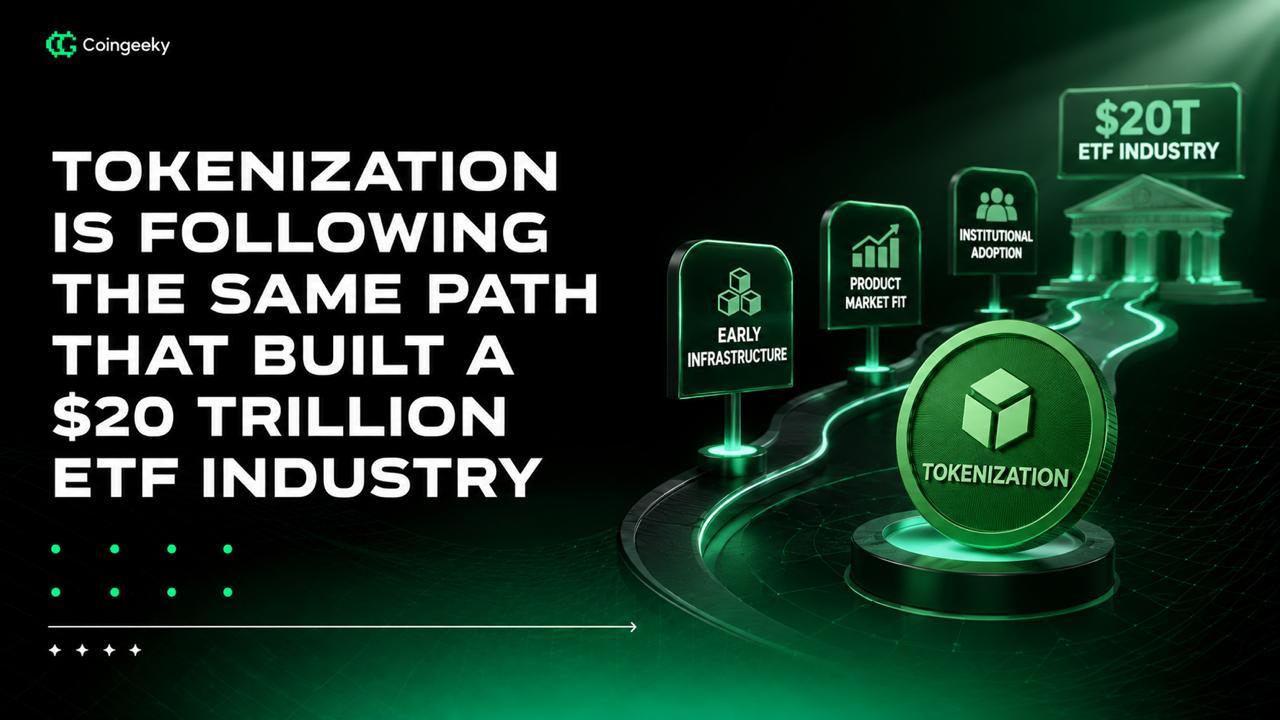
His argument: tokenization today looks almost identical to where ETFs stood in the early 2000s. And we all know how that story ended.
The ETF Parallel Is More Powerful Than It Sounds
Hoffman joined Ondo Finance after senior roles at Invesco and Grayscale, he's lived the ETF story from inside it. When he entered the ETF industry in the early 2000s, the total market held roughly $200 billion in assets. Today that figure sits near $20 trillion globally.
He recalled that ETFs were once called weapons of mass destruction, dismissed, misunderstood, and viewed with deep skepticism by the traditional finance establishment. The technology eventually won not because of hype, but because it made markets genuinely more accessible and efficient.
His view is that tokenization is running the same play, but faster. Every market that digitizes gets larger. Tokenization, in his framing, is the digitization of capital markets itself, not a product sitting on top of finance, but a structural rewiring of how markets function.
Where the Numbers Stand Right Now
The tokenized asset market has already crossed $33 billion, nearly tripling over the past year according to RWA.xyz. Citi projects the sector could reach $5.5 trillion by 2030. A separate forecast from Boston Consulting Group and Ripple puts the long‑term opportunity at $18.9 trillion by 2033.
Those are massive numbers, and Hoffman isn't even treating them as the ceiling. His point is that the biggest driver of tokenized asset demand hasn't properly arrived yet.
AI Agents Are What He's Actually Building For
The part of Hoffman's thesis that stands out most to me is his focus on artificial intelligence as the next, and potentially largest, demand driver for tokenized assets.
His vision is a future where autonomous AI agents don't just analyze markets but actively participate in them, buying, selling, and allocating capital through onchain investment products without waiting for human instruction. Real‑time portfolio management. Professionally managed strategies that adjust continuously as market conditions and data inputs change.
For that to happen, the infrastructure has to exist first. Tokenized assets, onchain prime‑brokerage capabilities, and asset management strategies that can execute natively on blockchain networks, all of it needs to be in place before AI agents can meaningfully operate as market participants.
What Ondo Is Building Toward
Ondo already offers tokenized U.S. Treasury products and is planning to expand into stocks, ETFs, and perpetual futures through its onchain marketplace. The firm's stated goal is to become the world's most trusted platform for intelligently managed onchain investment portfolios.
That's a specific and ambitious target. It acknowledges something most tokenization projects don't say out loud: owning the asset on a blockchain is the easy part. Building the portfolio infrastructure and management layer around it is where the real work lies.
Watching Hoffman lay out this roadmap, the ETF comparison doesn't feel forced to me. It feels like someone who has actually seen a structural market shift happen once before, and thinks they're watching the early frames of the same film again.