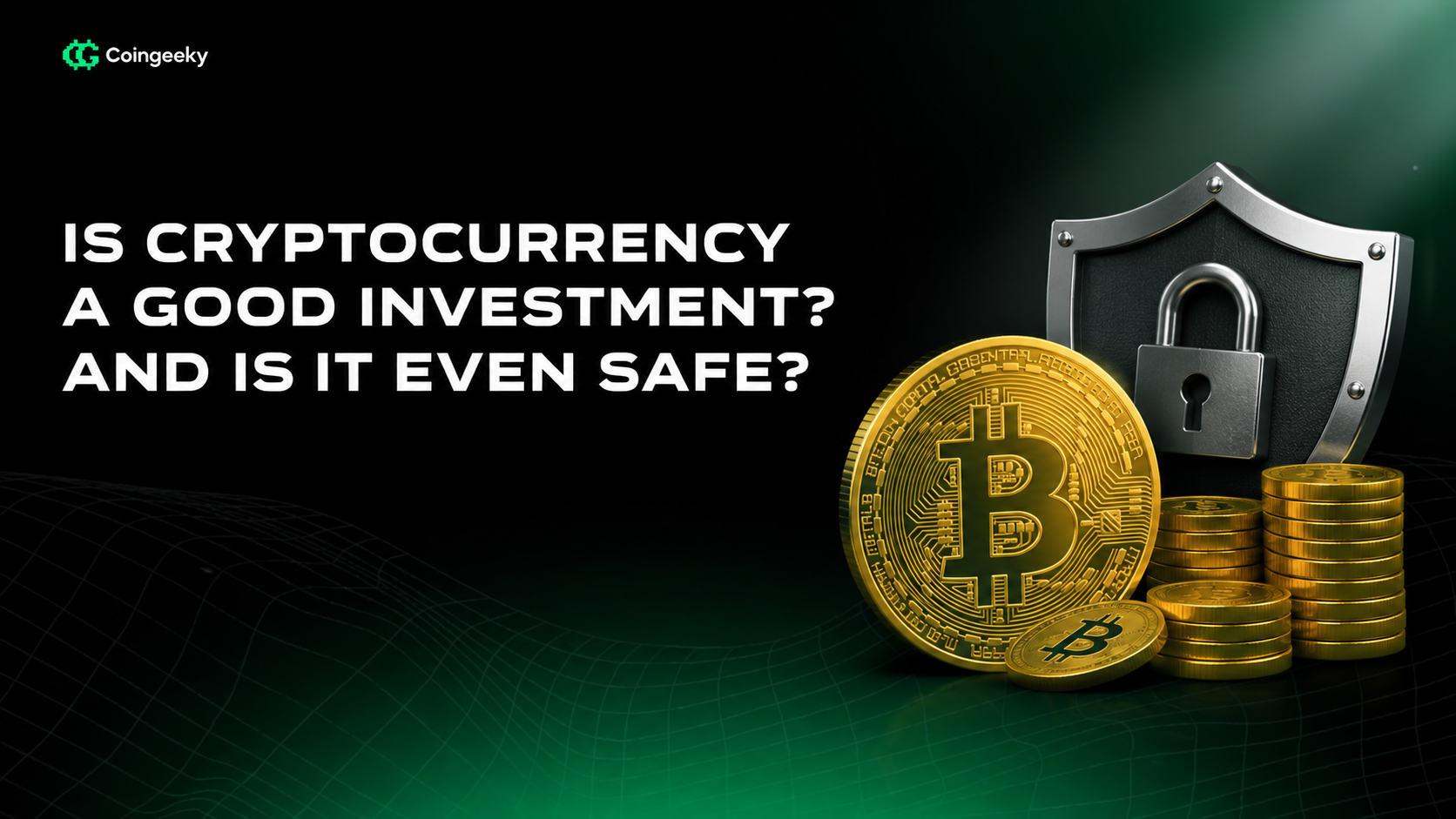

Short answer: crypto can be a good investment for a slice of money you're fully prepared to lose, and it is not "safe" in the way a savings account is safe. Those two facts live together. I've held some Bitcoin since 2019, and I've also watched coins I owned drop 80% and never come back. Both things are true at once. So if you came here hoping for a clean yes or no, I'm going to disappoint you, but I'll be honest about why.
Let me give you the version I'd give a friend over coffee. Treat crypto as the high‑risk corner of your portfolio. Keep it small. Hold mostly the big names. Learn to store it yourself. And never put in rent money. That's the whole strategy in four sentences. The rest of this piece explains the reasoning, because the reasoning is what keeps you from panic‑selling at the worst possible moment.
Is cryptocurrency a good investment?
Depends on what job you're hiring it to do. If you want something that pays you while you sleep, crypto is a poor fit. It throws off no dividends, no rent, no coupon. A share of a profitable company has earnings behind it. A bond has a contract. A Bitcoin has a network and a community of people who agree it's worth something, and that's a different animal entirely.
What crypto offers instead is asymmetric upside. You can lose 100% of what you put in. You cannot lose more than that (assuming you avoid leverage, which beginners absolutely should). But the gain side has no ceiling. Bitcoin went from pennies to a number I won't quote because it'll be stale by the time you read this. Check CoinGecko or CoinMarketCap for the live figure. The point is the ratio. Risk a small, defined amount; the payoff, if it works, dwarfs the stake. That math is the entire reason serious investors hold any at all.
There's a real track record now, too. Bitcoin has survived roughly fifteen years and several brutal crashes. Ethereum reshaped what a blockchain could do. And as I write this in 2026, spot Bitcoin and Ether ETFs trade on regular exchanges, which means a retirement account can hold exposure without anyone touching a wallet. That legitimacy didn't exist a few years ago. It matters. It pulled in pension funds and advisors who wouldn't have gone near a sketchy exchange.
So is it a good investment? For a 1% to 5% allocation, by people who've already got an emergency fund and a boring index portfolio, I think yes. For someone trying to get rich quick with money they need next month, no. Flatly no.
Is cryptocurrency safe, and how safe is it really?
This is where the word "safe" splits into two questions people keep mashing together.
Question one: is the price safe? No. Crypto swings violently. A 20% move in a day barely makes the news. Drawdowns of 70% or 80% have happened more than once, and they'll happen again. If watching a number fall by half would wreck your sleep or your finances, that volatility alone disqualifies it for you, and there's no shame in that.
Question two: is it safe to hold without getting robbed? That part is mostly in your hands. The technology underneath Bitcoin has never been hacked in any meaningful way. People lose money to exchange collapses, phishing links, fake apps, and "support" reps who DM them on Telegram. FTX didn't fail because Bitcoin broke. It failed because a company misused customer funds. So the honest framing is this: the asset is volatile, and the danger is mostly human, not cryptographic.
Are cryptocurrencies safe as a category? The blue chips and the garbage are not the same risk. A token launched last Tuesday by an anonymous team is a coin flip, and I'm being generous. Bitcoin and Ethereum are battle‑tested. Lumping them together is like comparing a blue‑chip stock to a penny stock because both are "equities."
What does "safe storage" actually mean?
You'll hear the phrase "not your keys, not your coins" constantly, and it's the single most useful sentence in this whole space. When your crypto sits on an exchange, you don't truly own it. You own an IOU. If that company freezes withdrawals or goes bankrupt, you're a creditor standing in line.
Real custody means holding the private keys yourself. For meaningful amounts, that means a hardware wallet, a little device from a maker like Ledger or Trezor that keeps your keys offline where no website can reach them. You write down a recovery phrase on paper, store it somewhere a fire or a roommate won't find it, and you never type it into a screen that asks for it. Anyone asking for your seed phrase is robbing you. No exceptions.
Is that a hassle? A bit. But it's the difference between owning an asset and trusting a stranger to hold it. I keep a small spending balance on a reputable exchange and the rest in cold storage. That split has saved people a lot of grief over the years.
Why cryptocurrency is bad, according to the critics
I'll steelman the other side, because the criticisms aren't dumb.
It produces no cash flow, so some of its value is a bet that someone else will pay more later. That's uncomfortably close to a greater‑fool dynamic, and pretending otherwise is dishonest. Scams are everywhere; the space attracts predators because transactions can't be reversed. Regulation is a moving target, and a single ruling in a major country can tank prices overnight. Energy use draws fair criticism, though it's shifted a lot. And the culture can be genuinely toxic, full of hype merchants who'll happily sell you a dream.
None of that makes crypto worthless. It does mean you should size your position as if you might be wrong, because plenty of smart people think you are.
Which cryptocurrency should I invest in?
I can't tell you what to buy, and anyone who confidently does, especially a stranger online, is someone to walk away from. What I'll say is structural. For most beginners, the largest, most liquid assets carry the least catastrophic risk. As of 2026 that's Bitcoin and Ethereum. They have the longest histories, the deepest markets, and regulated products built on top of them.
The smaller and newer a coin is, the more it behaves like a lottery ticket. Some pay off spectacularly. Most quietly go to zero, and you rarely hear about those. If you do venture beyond the top names, keep it to money you've mentally written off already. Don't chase whatever's pumping on social media this week. That timing game eats beginners alive.
How much should I put in?
Position sizing is the part nobody finds exciting and everybody regrets ignoring. My rule: only invest what you can lose entirely without changing how you live. For most people that's a small single‑digit percentage of investable money. Build the emergency fund first. Pay off the credit card. Then, with what's left over and truly discretionary, take your swing.
Dollar‑cost averaging helps enormously here. Buy a fixed amount on a schedule instead of dumping a lump sum and praying. It smooths out the wild entry timing and, just as important, keeps you from making emotional decisions when everyone on your feed is either euphoric or despairing.
A plain disclaimer
I'm not a financial advisor, and this article isn't financial advice. It's my opinion, shaped by my own wins and losses. Your situation, your taxes, and your risk tolerance are yours alone. Do your own research, and if real money is on the line, talk to a licensed professional before you act.