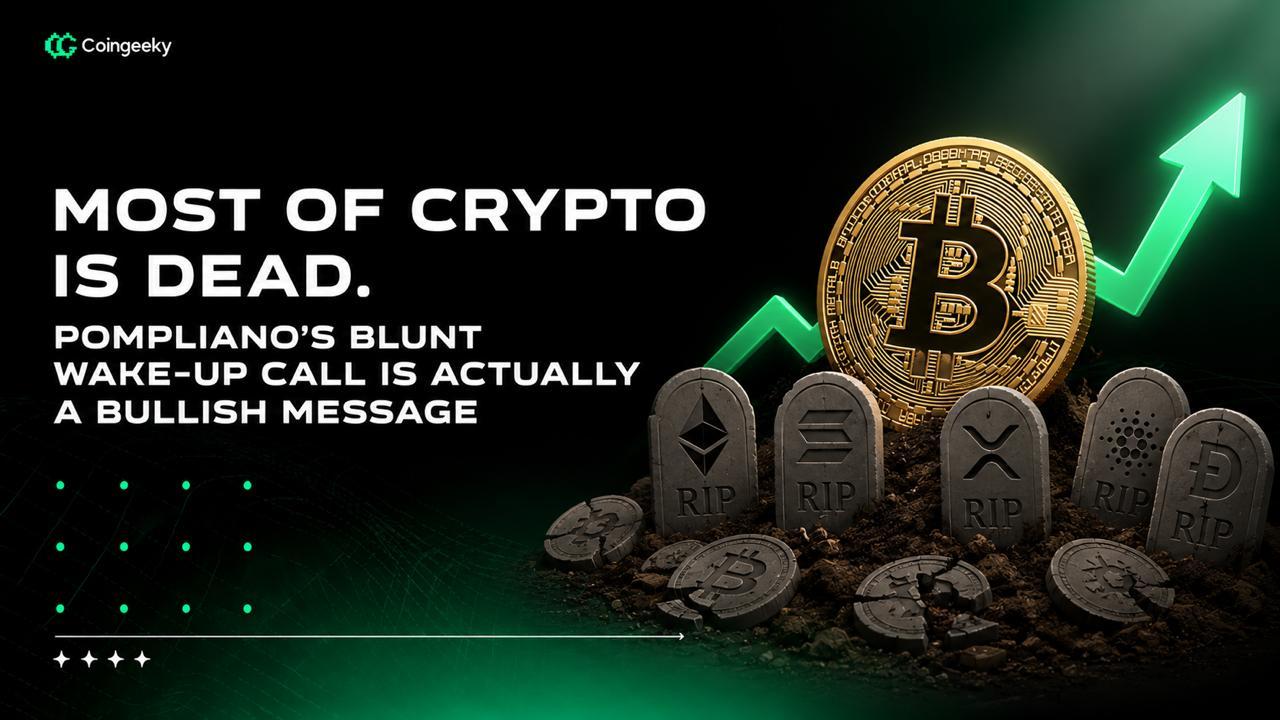

Tony Pompliano has never been one to sugarcoat things, but his most recent opinion shocked everyone in the crypto industry. The person who has supported Bitcoin for a long time said in a post that most of the crypto industry is already dead, which is exactly what needs to happen.
Pompliano wrote on X that "most of the crypto industry is dead and it's never coming back." He said that this statement stuck with him at the Consensus 2026 conference in Miami. "People have called me an idiot and told me I was wrong," he said. "I was at the Consensus Crypto Conference yesterday and was asked about the tweet at least fifty times." "But I'm more sure now than I was yesterday after spending the day at the conference."
Pompliano's argument is not a crypto obituary, though. It is more surgical, and surprisingly, it is hopeful about what lives on.
Ghost Chains and Zombie Coins
There is a flaw in the way the crypto market is built that is at the heart of his argument. In traditional industries, companies that didn't do well shut down. This freed up money and people to work on better ideas. In a healthy business cycle, getting rid of bad companies is almost as important as letting good ones grow. Crypto doesn't work like this, though, because blockchains almost never shut down and coins almost never go to zero.
Blockchains can still work technically even if only one or two people are running the network. This makes it look like there is activity. At the same time, coins lose most of their value and become less liquid. This leaves holders stuck with assets that are basically dead, like tokens that exchanges take off their lists or that stop being useful altogether. These things are known as "ghost chains" and "zombie coins" by Pompliano.
At Consensus, he asked the crowd if anyone thought millions of crypto coins would do well in the future. Exactly no one raised their hand. He said that the silence in the room meant that the industry was finally saying out loud what it had been afraid to say for a long time.
Missionaries vs. Mercenaries
Pompliano saw a problem with the culture in addition to the technical problems. He said that the people working in the industry have changed from "hardcore missionaries" who really believed in Bitcoin and the technology behind it to "mercenaries" who are looking for the trade with the biggest reward. This change can be seen in meme tokens that don't last long, scam coins, market manipulation, and product launches that are more about getting attention than making money.
He also said that traditional financial firms are getting into the crypto‑native sector with lower fees and bigger customer bases, which is putting more pressure on crypto‑native companies. Pompliano said that traditional brokerages are quickly adding crypto services to mainstream finance by mentioning Morgan Stanley's plans to let E*Trade offer Bitcoin trading.
What Survives the Purge
Pompliano's message isn't hopeless; it's a call to pay attention. He still thinks that Bitcoin, stablecoins, infrastructure, and tokenization will bring a lot of value. His main point is not that all crypto goes away, but that the speculative long tail does, and the useful parts are taken up by mainstream finance.
As more traditional banks add crypto services, infrastructure providers like custody firms, trading rails, and financial middleware companies will benefit. A process called "tokenization" represents traditional financial assets like stocks or real estate on blockchain networks. This is seen as one of the biggest long‑term opportunities because it could bring settlement systems up to date and lower the cost of transactions.
As Pompliano put it, "getting rid of bad companies is almost as important as keeping the good ones." "More people need to work on making real things that solve real problems."
O'Leary Agrees
Pompliano's comments were similar to what investor Kevin O'Leary said at Consensus 2026: most crypto tokens were not likely to recover. O'Leary said that he had cut his crypto holdings from 27 positions to three main ones: Bitcoin, Ethereum, and investments in infrastructure. He said that he did this because he believed that the next phase of growth for blockchain would come from businesses using it instead of speculative token launches.
The message from Miami was clear: the era of infinite tokens and empty chains is closing. What comes after it might be much stronger and more real.