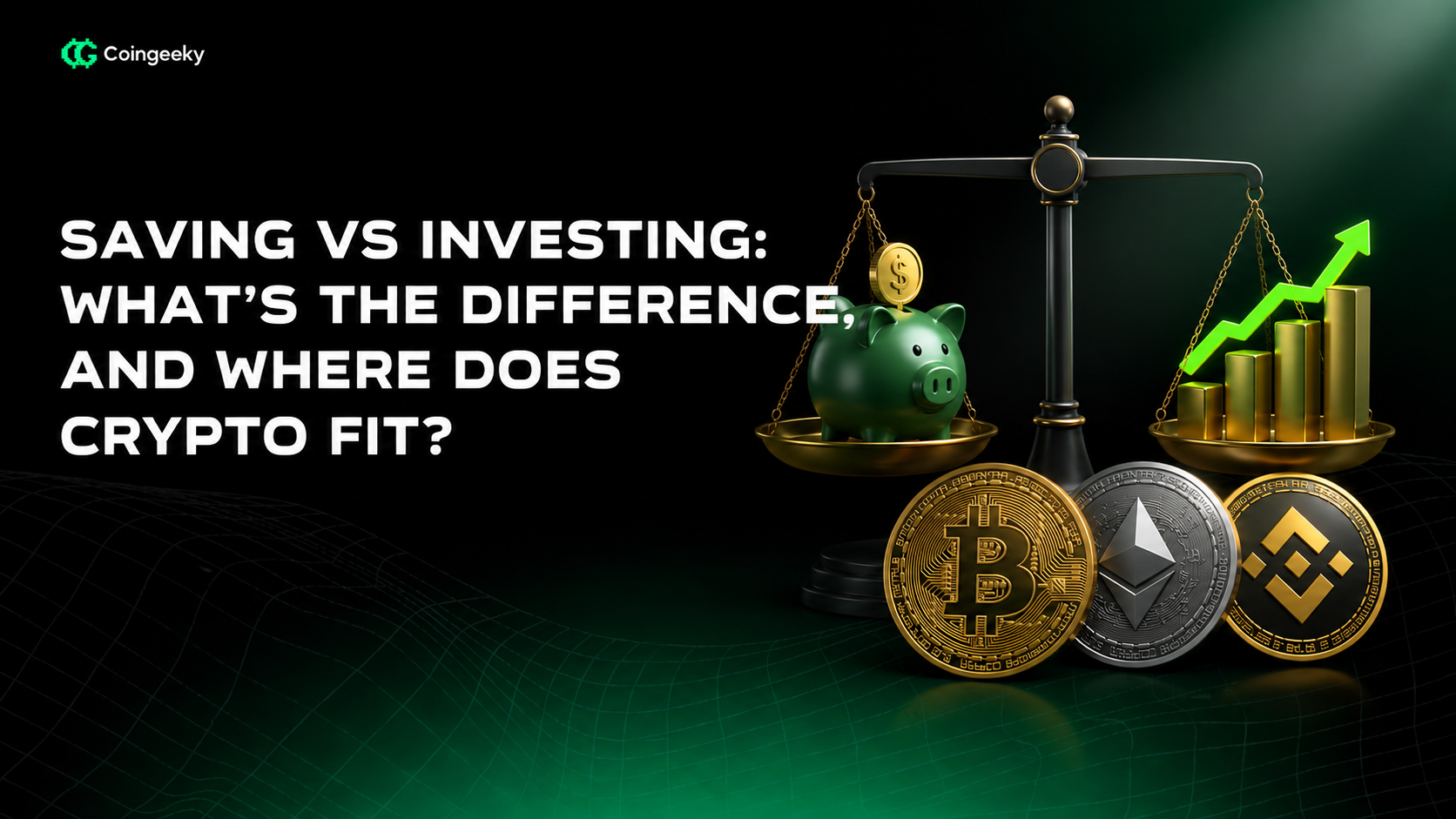

Saving and investing get treated like the same thing, and that quiet confusion is one of the most expensive mistakes people make with money. They're not the same job. Saving is about keeping money safe and within reach. Investing is about growing money you can afford to leave alone. Different goals, different tools, different risks, and getting them mixed up is how people end up with their rent money in something that can drop 40 percent overnight.
So let me untangle them properly, and then place crypto where it actually belongs.
What saving is for
Your savings sit in cash, in an ordinary account, boring and stable on purpose. The entire point is that the number doesn't move. You want it to be exactly there, untouched and predictable, on the random Tuesday when the car breaks down or the boiler dies. Savings aren't trying to grow much. They're trying to be reliable. A high‑yield savings account might add a little interest, but the job description is safety and access, not returns.
What investing is for
Investing is the opposite trade. You accept that the value will swing, sometimes hard and for uncomfortable stretches, in exchange for the realistic chance that it grows meaningfully over years. You're deliberately giving up short‑term stability to buy long‑term growth. That's a good trade, but only for money you genuinely won't need to touch for a long time, because being forced to sell an investment at a bad moment is how the trade turns against you.
Which comes first?
Saving. Always, without exception. Before a single dollar goes into any market, crypto included, you want an emergency fund, roughly three to six months of expenses, sitting in plain cash. That cushion is the thing that stops a surprise bill from forcing you to sell investments at the worst possible time, locking in a loss you'd otherwise have simply waited out. Skip the cushion and you're not really investing. You're exposed, one unlucky month away from being a forced seller.
I've watched people skip this step in a bull market because cash felt like it was 'missing out.' Then the surprise expense arrives, as it always eventually does, and they sell at exactly the wrong moment. The cushion isn't dead money. It's what makes the rest of the plan survivable.
So where does crypto fit?
Firmly on the investing side, and at the riskier end of it. Crypto is not savings. I genuinely can't say that loudly enough. Money you might need this year has no business in something that can fall 40 percent in a month and stay down for longer than you'd expect. Your rent fund does not belong in Bitcoin, no matter how convincing the chart looks on a given afternoon.
Think of your money as layers. Cash savings form the base, the foundation everything else rests on. Steady long‑term investments sit in the middle. Then, and only with money you could genuinely afford to lose, a small crypto slice goes on top. If that top layer wobbles, and it absolutely will, the foundation holds and your actual life carries on undisturbed.
Getting the order right
When you build it in that order, crypto becomes what it should be: an interesting, high‑upside bet you can afford to be wrong about. The swings stop feeling like emergencies, because they're happening to a slice you'd already mentally written off as risk capital. You can hold through a brutal drawdown calmly, which is exactly when most returns are actually won or lost.
Get it backwards, with your safety money parked in volatile assets and no cash cushion underneath, and even a genuinely good year somehow manages to feel like constant stress. Every dip threatens something you can't afford to lose, so you make panicked decisions at the worst times. The boring base layer isn't the unexciting part of the plan. It's the part that makes the exciting part survivable, and survivability is the whole game over a long enough horizon.