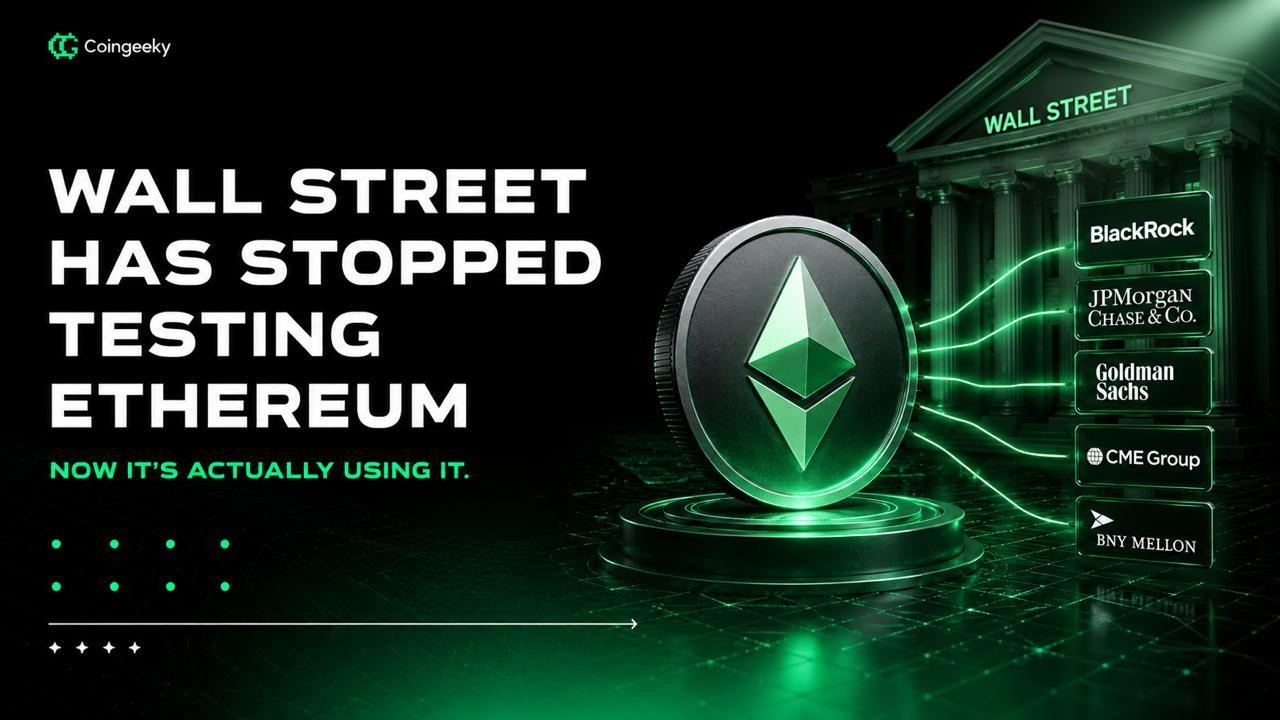

There's a phrase I kept hearing throughout 2024 and 2025 whenever I asked big financial institutions about blockchain: proof of concept. Everything was exploratory. Everything was a pilot. Nobody was committing.
That language is changing, and Vivek Raman, founder of Etherealize, a firm focused on bringing Ethereum to Wall Street.
From Dipping a Toe to Jumping In
Raman described the shift plainly. A year and a half ago, institutions were cautiously experimenting, treating public blockchains as an emerging technology to be studied rather than deployed. That posture has flipped.
The conversations he's having now are no longer about whether to use public chains. They're about how fast to move and what assets to bring onchain first. He compared the current moment to how the financial world eventually adopted the internet, not as a novelty, but as foundational infrastructure that simply gets used.
Ethereum's dominance in stablecoins, institutional‑grade liquidity, and real‑world deployments has created a network effect strong enough to pull traditional finance in. Once the liquidity hub was established, Raman said, institutions started asking a natural follow‑on question: what other assets can we bring here?
The answer, in conversations he's having across Wall Street, spans tokenized stocks, bonds, fixed income instruments, real estate, and investment funds. The full menu of traditional finance, being rebuilt on Ethereum rails.
Why ETH's Price Hasn't Caught Up Yet
Here's the frustrating part for anyone holding ETH right now. Despite all of this institutional momentum, the price of ETH has badly underperformed Bitcoin and several other major tokens this cycle. Raman has a clear explanation for that gap, and it comes down to timing.
Institutional sales cycles are long. The decisions being made in boardrooms today will take months, sometimes years, to translate into assets actually moving onchain. The infrastructure is built. The legal frameworks are being established. But the bulk of tokenized assets haven't migrated yet.
Raman's view is that Ethereum is sitting in a specific transitional phase: the pipes are laid, but the water hasn't fully started flowing. When it does, he believes the market will recalibrate how it values ETH as the asset that secures the network underneath all of it.
His take on how history will record this moment is direct, when people look back, the narrative will be that the global financial system's internet moment happened on Ethereum.
The Ethereum Foundation Question
Raman also addressed the criticism that's been swirling around the Ethereum Foundation following leadership changes and internal restructuring. His position is that the foundation stepping back is exactly what should happen.
The substrate for a global financial system cannot have a single controlling party, he said. The network's value proposition is precisely that it's universal and neutral. As the ecosystem matures, the foundation's role should narrow to preserving Ethereum's core values, security, censorship resistance, privacy, and open standards, while continuing long‑term technical work on zero‑knowledge proofs and quantum resistance.
The Measure of Success
What I found most striking about Raman's framing is how he defines whether Ethereum actually wins. It's not the price. It's not market cap rankings.
The highest calling for any blockchain, he said, is real users, sustainable assets, and actual utility. By that measure, Ethereum already has the strongest case of any network in the space. The price, he believes, will follow, it just needs time for the institutional flywheel to fully spin up.
I'm watching that timeline closely. The infrastructure story checks out. Now it's about execution.