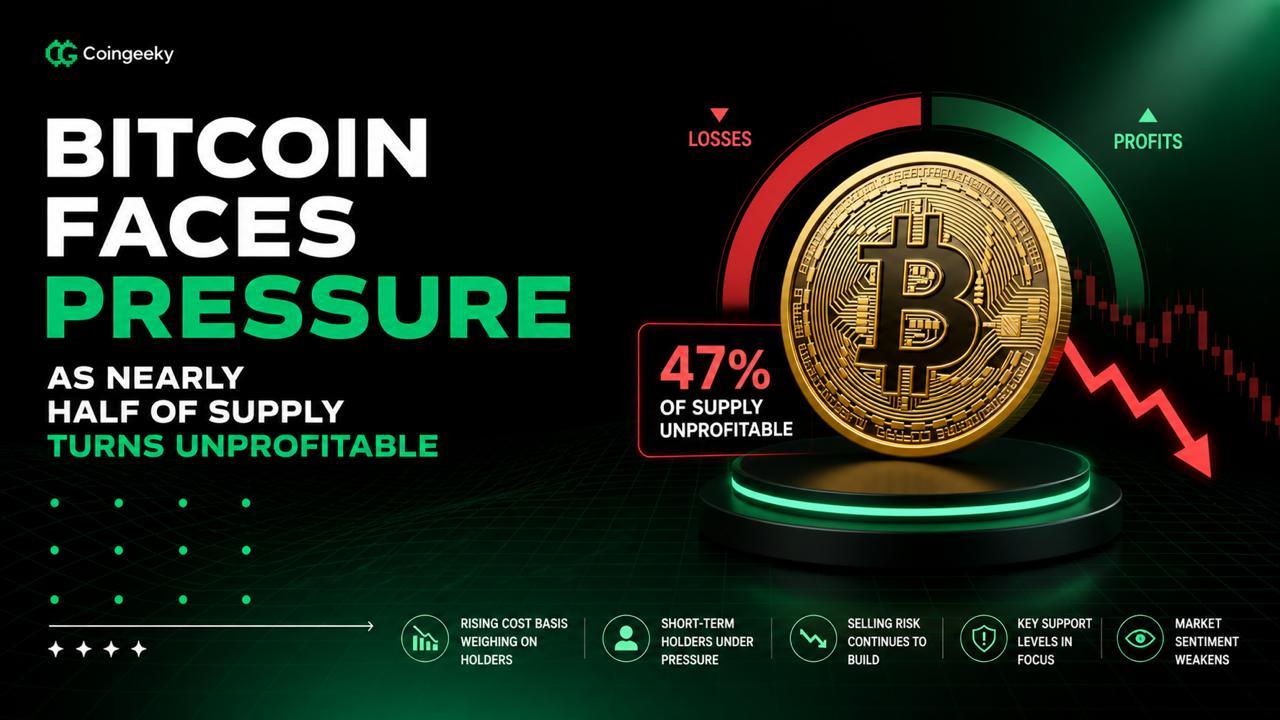

Bitcoin is currently flashing a significant warning signal as a large portion of its circulating supply has fallen into loss territory. New information from the blockchain shows that about 9 million Bitcoin, or 45–46% of all Bitcoin, is now held at a loss. This means that these coins were last traded when their value was higher than it is now.
This development has historically marked critical turning points in the market. When such a large percentage of supply becomes unprofitable, it typically signals either a period of strong capitulation or the early stages of accumulation by long‑term investors.
A Pattern Seen in Previous Cycles
Looking back, similar conditions appeared during past bear phases, including 2018, 2022, and early 2023. Most of the time, the market went down even more, sometimes by as much as 25% or more, before it stabilized.
However, there are exceptions. In early 2023, instead of a sharp drop, the market entered a consolidation phase and later recovered. The difference then was reduced sell pressure, suggesting that investor behavior plays a key role in determining outcomes.
Mounting Losses and Market Stress
Short‑term holders are currently facing the brunt of the losses, with unrealized losses estimated at over $113 billion. At the same time, bigger market indicators like the Bitcoin Impact Index have risen into high‑stress levels, which are often linked to big price changes.
At the same time, Bitcoin’s price remains significantly below its previous peak, trading roughly 40–50% lower than its all‑time high. This has intensified pressure across the market, particularly among newer investors.
External Factors Adding Pressure
Institutional flows are also contributing to the uncertainty. Spot Bitcoin ETFs have seen notable outflows, with investors currently sitting on losses based on their average entry prices. Large holders, who are sometimes called "whales," have also been lowering their positions, which has added more supply to the market.
These combined factors suggest that the market is still under strain, with sentiment leaning toward caution.
What Happens Next?
The market now faces a critical phase. If selling pressure continues to build, further downside could follow. On the other hand, if long‑term investors begin accumulating and selling slows, this could mark the beginning of a recovery phase.
Key levels to watch include support zones near recent lows and resistance levels tied to the average purchase price of short‑term holders. Additionally, ETF inflows and whale activity are likely to be major indicators of the next directional move.
Final Takeaway
The fact that nearly half of Bitcoin’s supply is underwater highlights the current fragility of the market. While this situation has historically preceded both sharp declines and strong recoveries, the outcome will depend largely on investor behavior and broader market conditions.
At the moment, Bitcoin seems to be in a transitional phase, stuck between more pressure and the chance for long‑term growth.