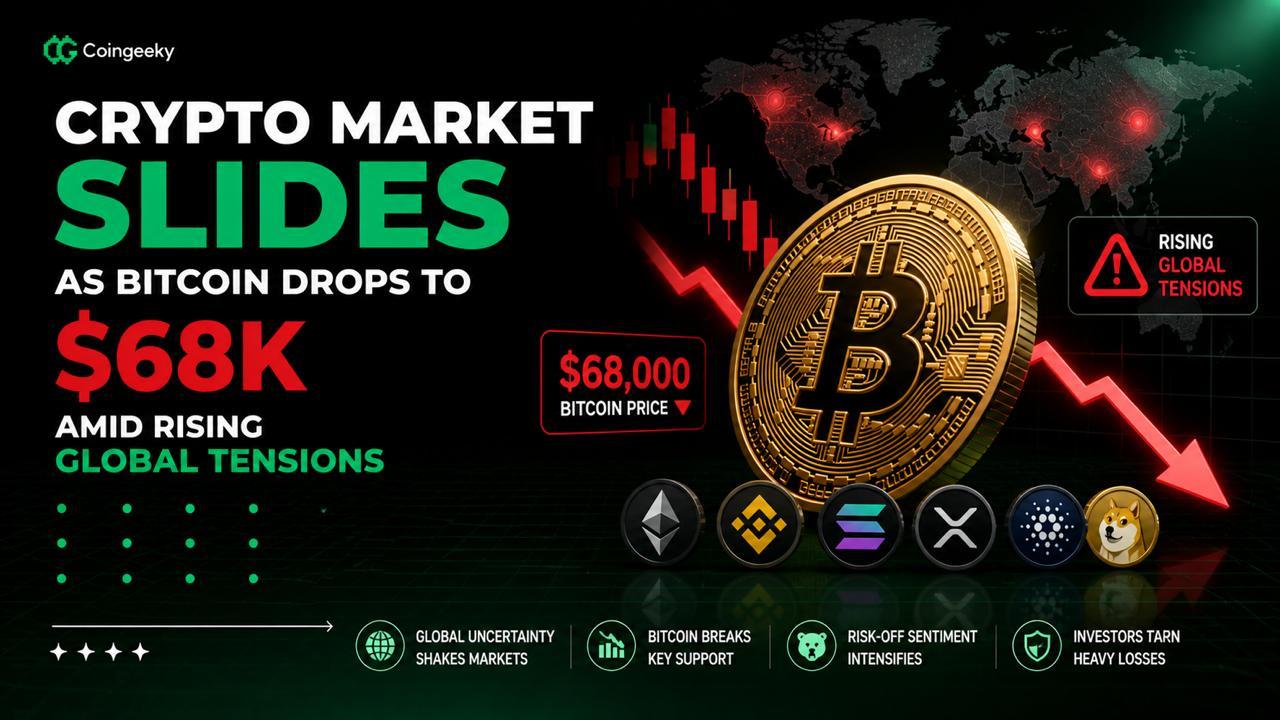

The cryptocurrency market witnessed fresh volatility as Bitcoin slipped to the $68,000 level, dragging major altcoins down alongside it. The decline comes at a time when global financial markets are reacting to rising geopolitical tensions, particularly involving the United States and Iran.
While crypto markets have seen sharp rallies recently, the latest dip highlights how sensitive digital assets remain to macroeconomic and political developments.
Bitcoin Falls After Brief Rally Above $70K
Bitcoin, the world’s largest cryptocurrency, had recently crossed the $70,000 mark, sparking optimism among investors. However, that momentum proved short‑lived.
The price dropped over 2% before stabilizing around $68,000, effectively wiping out gains from the previous trading session.
This movement reflects a broader pattern seen in 2026: Bitcoin reacts quickly to global news, rising on positive developments and falling sharply during uncertainty.
Ethereum and Altcoins Mirror the Decline
The weakness wasn’t limited to Bitcoin. Ethereum, the second‑largest cryptocurrency, also declined by nearly 2–3%, while other major tokens followed suit.
Popular altcoins like XRP, Solana, and Dogecoin showed minimal recovery, staying close to previous levels or slipping further.
Overall, the market displayed a synchronized pullback, indicating that investor sentiment across crypto remains cautious rather than selective.
Geopolitical Tensions Trigger Market Uncertainty
At the center of this market movement is rising geopolitical risk. Investors are closely watching developments around the U.S. deadline for Iran to reopen key oil routes, with the threat of military escalation looming.
These tensions have also had a negative effect on global markets, such as stocks and commodities. It's now more than $110 a barrel for oil, which makes people worry about inflation and the economy.
In such scenarios, investors often reduce exposure to riskier assets like cryptocurrencies, leading to short‑term sell‑offs.
Crypto Markets React Faster Than Traditional Assets
One unique aspect of this cycle is how quickly crypto markets respond to global developments. Unlike traditional financial markets, crypto trades 24/7, making it the first to reflect real‑time sentiment shifts.
Analysts note that Bitcoin has been moving within a wide $65,000–$75,000 range, reacting instantly to news around ceasefires, negotiations, or escalation.
This makes crypto both an opportunity and a risk, as prices can swing significantly within hours.
Institutional Interest Remains Strong
Despite the recent dip, there are signs that long‑term confidence in crypto remains intact.
Institutional investors continue to show interest, with Bitcoin ETFs seeing steady inflows even during market declines.
This suggests that while short‑term traders may be cautious, larger players are still accumulating positions, viewing dips as buying opportunities.
Market Outlook: Volatility Likely to Continue
Looking ahead, the direction of the crypto market will largely depend on how geopolitical events unfold.
If tensions ease or diplomatic solutions emerge, Bitcoin could regain momentum and push toward previous highs. On the other hand, further escalation could lead to additional downside pressure.
For now, the market remains in a “wait‑and‑watch” phase, with investors closely tracking global developments rather than purely crypto‑specific factors.
Conclusion
The recent drop in Bitcoin to $68,000 is less about crypto fundamentals and more about global uncertainty. As geopolitical tensions rise, investors are becoming more risk‑averse, leading to temporary pullbacks across digital assets.
But the fact that institutional investors are still putting money into crypto shows that the overall bullish story is still true. In the short term, the market is likely to be volatile. But in the long term, the direction of the market will depend on how global risks change.